
By Thomas Birchall

Situated in the heart of a racially, culturally, and socioeconomically diverse neighborhood in the nation’s capital, a modest, pale yellow residence calls itself home to the Washington Buddhist Vihara Society. In keeping with the area’s quiet, multicultural ambiance, the monastery seeks to create an all-inclusive space of serenity in which all visitors, regardless of religious affiliation, are invited to participate in Vihara activities, explore the extensive library, or find tranquility within the confines of the meditation or shrine rooms.
Mission
With the intention of effectively disseminating the knowledge of Dhamma (teaching) of the Buddha, the WBV, since it came to fruition, has sought to enforce a policy that transcends ethnic and cultural boundaries. That is, though people of many nationalities visit the Vihara, all regular services are conducted in English, making for an accessible space of academia/religiosity which has, in turn, expedited the introduction of Buddhism to the US. As there are no linguistic barriers, visitors and devotees who speak different languages express feeling quite at home at the Vihara.
Brief Chronology
Founded in 1965 and incorporated as a society the following year under the patronage of the Most Venerable Madihe Pannasiha Mahanayaka Thera (pictured below), the WBV was established as the first Theravada Buddhist monastic community in the United States. Sent by the Asia Foundation on a tour, the Sri Lankan monk happened to be in Washington on Vesak, the Buddhist holiday that commemorates the birth, death, and enlightenment of the Buddha. He celebrated in a park with a few people from the Sri Lankan Embassy and, after conversations with an officer from the embassy, decided to form a temple in the United States.
 Ever since its inception, the Vihara has been dedicated to the presentation of Buddhist thought, practice, and culture by identifying as an educational, as well as religious organization. Staffed by resident bhikkhus (monks), these ordained male monastics are available to discuss the various aspects of Buddhism, teach meditation, and offer informal courses; they are also willing and able to give lectures and lead meditation workshops at universities, schools, churches, and other community groups. There has been a succession of scholarly monks who have come to take over the presidency of the Vihara Society and oversee the administration of the temple, each of whom has possessed the skills, knowledge, insight, and commitment to add important improvements to the temple, as well as to the status of Buddhism in America.
Current Standing
As declared in a statement from the current president of the Vihara Society, “in spite of the great advances made in scientific technology, and the development of many products and services, man has not made any significant progress in his inner development, as individuals, societies or nations.” In the face of horrific actions on behalf of humankind within the context of modern wars, famine, among countless other atrocities, maintaining hope of making worthwhile progress seems an arduous task. Drawing from the Buddha’s teachings from over twenty five centuries ago, however, the WBV turns to the ageless knowledge of the roots of suffering with the hopes of remedying said evils. In this strife-torn modern world, then, the Vihara considers it of paramount importance to convey to all, very clearly and lucidly, the saving message of the Buddha by pointing to the natural, human way to freedom from evil and suffering. As such, through the wisdom of the Buddha’s Dhamma, the WBV seeks to guide the forlorn modern generation along the way to world peace and to the ultimate peace of Nirvana.

Far from an easy task, the Vihara Society approaches this game plan with a specific dogmatic strategy, informed by the Theravada tradition, or the “doctrine of the elders,” referring to the school of Buddhism that draws its scriptural inspiration from the texts of the Pali Canon, or Tipitaka, which is generally believed to contain the earliest surviving record of the Buddha’s teachings. It is spoken of as the most conservative tradition, in the sense that Theravadins want to preserve the original teachings and not modify them to suit the changing times; this manifests itself in the form of maintaining the same ancient rules of religious discipline, including the color and pattern of the robes of monks.
Meditational Framework
Buddhist meditation, as it is taught at the WBV, is not a mystical practice; rather, it is meant to be a stress-relieving technique tailored to suit people who are living secular lives as workers with responsibilities and who are involved in various relationships. So as to help such individuals attain peace of mind, healthy relationships, self-confidence, success in life, and efficiency at work, the Vihara stresses the importance of learning to gain control over the emotions that prevent one from thinking rationally or acting intelligently, which may come in the form of anger, lust, worries, fears, and anxieties. As such, the form of Buddhist meditation taught here helps one free the mind of emotional disturbances and, in turn, to think clearly and act rationally.
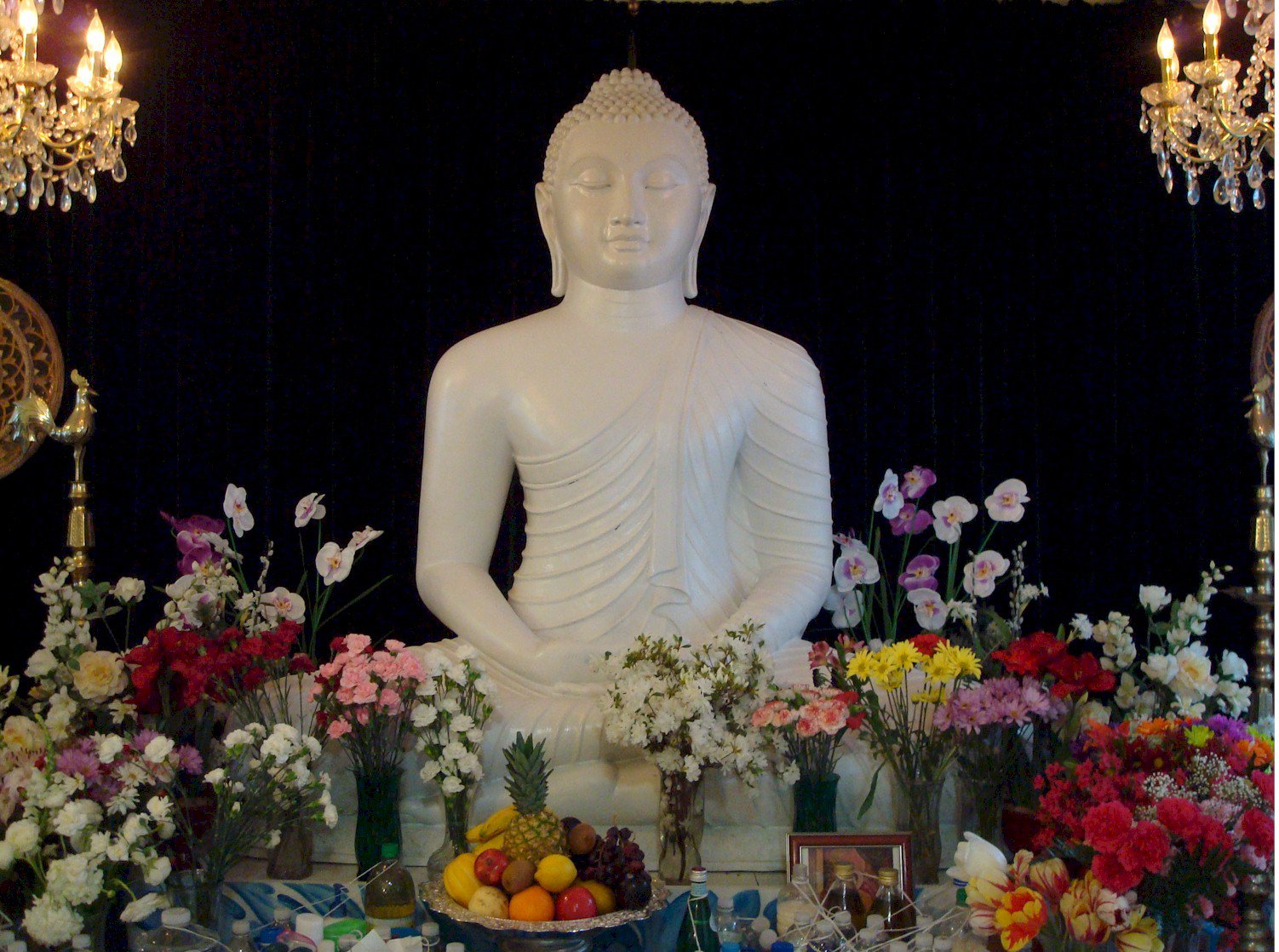
The particular method that is practiced, in essence, involves an effort to consciously purify and tranquilize the mind that is aimed at developing a relaxed body and a calm mind, resulting in the experience of happiness and a kindness of heart. This manifests itself in the form of samatha, referring to the cultivation of tranquility, and vipassana, which describes the direct analytical awareness of the totality of experience at a given moment. Buddhist meditation, as spoken of at the WBV, is a growth technique, where the purpose of the practice is to grow to a higher level of emotional maturity through mental purification so as to lead a life of wisdom that is dominated by reason rather than by emotion. It is evident, then, that an effort is made to speak of the experience of Nirvana as an attainable, accessible state of being with palpable outcomes.
Typical Week
Activities are abundant, with something going on every day of the week, always open to all. On Mondays, Tuesdays, Thursdays, and Fridays at 7pm, for example, there is a meditation program conducted by Venerable Bhante Mandawala Pannawansa; Hatha Yoga takes place on Wednesdays.
“It’s very peaceful,” said Robert Rhyne, 45, a lawyer who has been a Buddhist for more than a decade and who sometimes leads the meditations. “People just enjoy the sense of peace . . . There’s little ritual so it’s easy for Westerners to come.”
Every other Friday at 7pm, there is a Buddhist studies group, which considers itself an “informal Theravada Buddhist study group,” whose goal is to support and enhance participants’ practice and knowledge of Buddhism; their meetings are led by individual volunteer members and typically include readings and discussions of suttas (discourses) by the Buddha from the earliest sources—Theravada, Pali Canon—as well as Buddhist topics closely linked to and supported by the suttas. Topics are wide-ranging, from compassion and mindfulness to practical day-to-day applications; the small group consists of individuals with varying degrees of experience regarding teachings of the Buddha, and they encourage others to join them who have “sincere interest, an open mind, and a loving heart.”
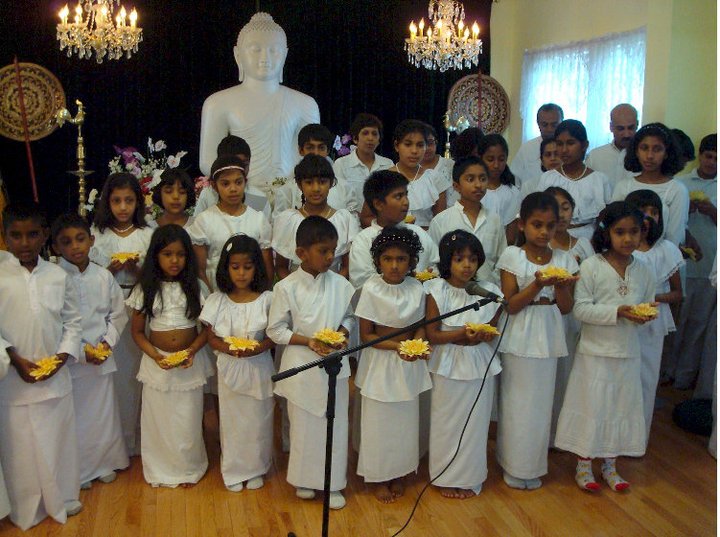
Saturdays at 6pm there is a meditation program also conducted by Venerable Bhante Mandawala Pannawansa; Sundays at 3pm there is a Vandana, which is comprised of a devotional service, dhamma discussion, and a guided meditation conducted by Pannawansa; there is a dhamma school for children, which is conducted in English- the class meets from 9:45 am to noon every other Sunday and is open to children of all ages (books and other reading materials are provided free of charge; topics of discussion include the life of the Buddha, the Dhamma, the Arahants, and Jataka tales); monthly, there is the Uposatha Full-Moon (Poya) Day Observance; there are also periodic meditation retreats, organized in conjunction with their sister organization, the Bhavana Society.
Given the allotted time frames, activities, and structure of the Vihara, numerous recurring themes can be noted as the narrative of Buddhism in the west continues to unfold, including the pragmatic element of meditation marketed as a tool to overcome certain problems; the dichotomy between reclusion vs. engagement, where most members typically go about their lives immersed in an urban space, coupled with the activities held following the usual work day; the idea of democratization as central to making Buddhist practices accessible to all in an equal fashion. In terms of the community’s constituency and ethnic composition, it is worth reiterating that the Washington Buddhist Vihara has been an international temple from the beginning, where Buddhists and friends of Buddhism from Sri Lanka, Thailand, Bangladesh, Burma, and America are included among the temple’s regular members. Sri Lankans and other Asians tend to come for devotional services and ceremonies, while white Americans come for meditation sessions and sutta study classes (in fact, almost one half of the WBV’s membership is made up of local Americans!).
Community Impact
Ambassador Kariyawasam read the message of President Maithripala Sirisena (of Sri Lanka) for the 50th anniversary of the WBV, in which he stated that the occasion “provides an ideal moment for us to reflect on the wide-ranging role played by the Washington Buddhist Vihara in the cultural and religious spheres in the American Buddhist Society in general and for the welfare of Sri Lankan American community in the region as well.” President Sirisena further added that “Admirably, the Vihara has become a center for taking teachings of Lord Buddha and Buddhist practice to the wider American community as well. Sri Lankan Buddhist temples abroad function as a window to Sri Lankan culture and as a platform for socio-cultural interaction for those of Sri Lankan origin living abroad.”
It appears that Buddhist temples, then, can play a pivotal role for wider socio-cultural harmony and for the holistic upliftment of people both in their homeland and abroad. In its conception outside of Sri Lanka and function as a unifying meeting space for expatriate Sri Lankans and locals alike, the Washington Buddhist Vihara Society seems to be successfully bringing together numerous individuals, irrespective of ethnicity and belief system, to direct their energies towards inclusive national development with the objective of building a peaceful and prosperous country consisting of mindful, active citizens.
Bibliography
Cadge, Wendy. Heartwood: The First Generation of Theravada Buddhism in America. Chicago: University of Chicago Press, 2008.
“GOLDEN JUBILEE CELEBRATION OF WASHINGTON BUDDHIST VIHARA .” Embassy of Sri Lanka, Washington, D.C., 3 May 2016, slembassyusa.org/embassy_press_releases/golden-jubilee-celebration-of-washington-buddhist-vihara/.
McLaughlin, Moira E. “Meditate Washington Buddhist Vihara to Relieve Holiday Stress.” The Washington Post, WP Company, 20 Dec. 2012, www.washingtonpost.com/goingoutguide/meditate-washington-buddhist-vihara-to-relieve-holiday-stress/2012/12/20/34ffe58a-3cbd-11e2-a2d9-822f58ac9fd5_story.html.
“The Washington Buddhist Vihara.” International Buddhist Committee, www.ibcdc.org/temples/wbv.htm.
“Washington Buddhist Vihara Home Page.” Washington Buddhist Vihara, 2000, www.buddhistvihara.com/.