Introduction:
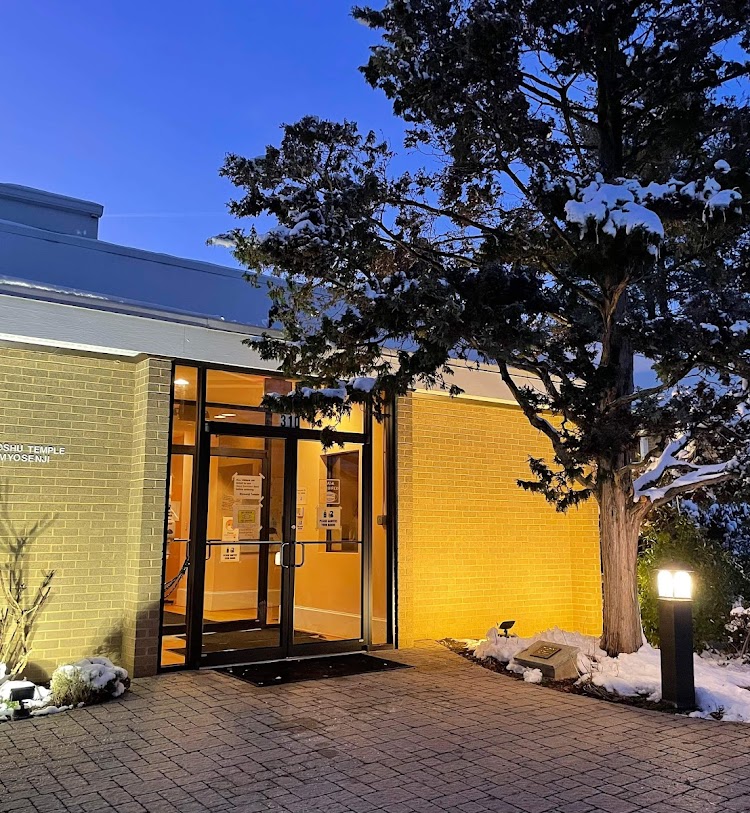
The Myosenji Temple is located in Silver Spring, Maryland near Washington D.C. It exists as part of a larger organization based in Japan known as Nichiren Shoshu, which is a sect of Nichiren Buddhism.
History of Nichiren Buddhism and Nichiren Shoshu:
Nichiren Buddhists believe that Siddartha Gautama’s teachings are no longer a viable way to achieve awakening so long after his death, and that he prophesied the arrival of a greater teacher who would help people attain enlightenment in a degenerate age. They understand this teacher to be Nichiren, whom they revere as the “True Buddha”, a 13th-century Japanese priest who founded the sect that bears his name. Nichiren’s central teaching was that chanting the title of the Lotus Sutra, “Nam Myoho Renge Kyo,” and reciting the Sutra would allow practitioners to attain enlightenment. Nichiren also created Gohonzons, calligraphic mandalas composed of Chinese and Sanskrit characters that Nichiren Buddhists believe form the essence of the Lotus Sutra. The Nichiren Shoshu sect has adopted one of these, known as the Dai-Gohonzon, as its fundamental object of worship. Nichiren’s fierce condemnations of other schools and the government authorities that supported them led to his exile in 1261-1263 and 1271-1274, but he was still able to establish a priestly legacy (Stone, 2012). As the first High Priest of Nichiren Buddhism, Nichiren transmitted the Dai Gohonzon to Nikko Shonin, the second High Priest. Nikko Shonin would later found the Taisekiji temple in 1290 which would become the head temple of the sect (Nichiren Shoshu, 2025b).
With its focus on the Lotus Sutra, Nichiren Buddhism clearly positions itself as part of the Mahayana tradition, and its experiential nature and practice of chanting resemble other forms of East Asian Buddhism such as Pure Land. However, Nichiren Buddhism itself is split into various sects with Nichiren Shoshu being only one. Nichiren Shoshu views itself as the modern manifestation of an unbroken priestly lineage leading to Nichiren, but the actual organization dates back to 1900 when the Taisekiji temple split from the Honmoshu school, and the current name originates from 1913 (Matsunaga & Matsunaga, 1976, p.181). The sect saw rapid growth after the establishment of the Soka Gakkai lay organization in 1930, and especially following World War II (Nichiren Shoshu, 2025a) (Métraux, 1992). Soka Gakkai initially served as a sister organization to Nichiren Shoshu that would help bring new followers to the religion in ways that a small and traditional priesthood might not be suited for.
Yet while Soka Gakkai succeeded in bringing new adherents to the movement and raising funds through donations, it came into conflict with the priesthood over their role and authority. In 1991 the priesthood excommunicated Soka Gakkai, and the organizations split apart, with some lay members remaining with Nichiren Shoshu, but most joining Soka Gakkai (Métraux, 1992). This split was quite bitter and one can still observe animosity between the two organizations today, with the current high priest comparing worshipping the Soka Gakkai Gohonzon to worshipping the devil (Nichiren Shoshu Myosenji Buddhist Temple, 2025).
History of the Myosenji Temple:
The Myosenji Temple was established in 1972 by Reverend Yogaku Iwaki, its first chief priest, in a house in Hyattsville, Maryland. Construction of the actual structure began in 1979 in Silver Spring, Maryland, and ended in 1980 when the temple was opened (Montgomery County Planning Board, 2025). Since Iwaki returned to Japan soon afterward, there is little information about him. In 2009, a fire damaged the temple, leaving it unsuitable for practice until it was re-opened in 2012 (Nichiren Shoshu Myosenji Buddhist Temple, 2012). As of writing, the current chief priest is Reverend Shojo Sakabe (Myosetsuji Temple, n.d.).
Practices of the Myosenji Temple:
The central practice of Buddhism at the Myosenji Temple is chanting “Nam Myoho Renge Kyo,” the title of the Lotus Sutra, known as the Daimoku (Stone, 2012). This chanting is done while facing the Dai-Gohonzon or a copy of it in a temple or home altar. It is important that such a copy is created by a priest so that the enlightenment of the original Dai-Gohonzon is preserved (MacWilliams, 2006). Furthermore, for the Daimoku to work, a person must perform it sincerely with the belief that it will lead them to enlightenment. In addition to the Daimoku, practitioners recite parts of the Lotus Sutra, and together these practices are known as the Gongyo. The Gongyo is essential to Nichiren Buddhism and the temple website suggests performing it daily in the morning and evening. The claim of Nichiren Shoshu is that these practices will put a person on the path to enlightenment and get rid of their negative karma. Enlightenment in a Nichiren context signifies a fusion between the enlightened one’s life and the ultimate truth of Buddhism embodied in the life of Nichiren, allowing one to fulfill their potential to become a Buddha. Another important practice in Nichiren Shoshu is a pilgrimage to the Taisekiji temple in Japan which is the head temple of the religion. The pilgrimage allows one to perform Gongyo before the Dai-Gohonzon and the head priest, and thus bring oneself closer to ultimate Buddhist truth (Myosenji Buddhist Temple, 2006a) (Myosenji Buddhist Temple, 2013a).
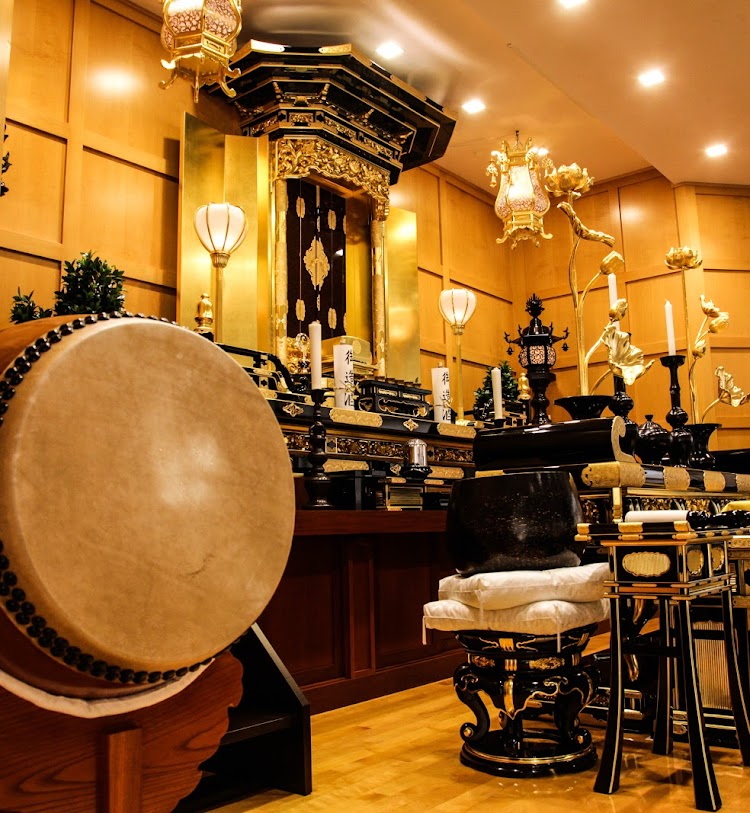
The physical space of the temple consists of an altar before which the priests speak that faces several rows of chairs where lay practitioners sit. The altar contains various offerings to the Buddha Nichiren including food, water, candles, and incense (Nichiren Shoshu Myosenji Buddhist Temple, 2012) (Nichiren Shoshu Myosenji Buddhist Temple, 2014) (Nichiren Shoshu Myosenji Buddhist Temple, 2015) (Nichiren Shoshu Myosenji Buddhist Temple, 2020b). The temple offers morning and evening Gongyo every day, along with several other ceremonies and events. The Oko ceremony occurs monthly during which members perform the Gongyo and listen to a lecture by the chief priest. It is a way of expressing gratitude for Nichiren, the Dai-Gohonzon, and the priesthood. (Nichiren Shoshu Myosenji Buddhist Temple, 2019). Memorial ceremonies are also conducted monthly, during which members offer incense and receive Toba tablets representing the bodies of the dead as the five classical elements. The temple also offers introductory lectures for those new to Nichiren Buddhism about once or twice every month (Nichiren Shoshu Myosenji Buddhist Temple, 2021) (Myosenji Buddhist Temple, n.d.).
Community of the Myosenji Temple:
The temple prides itself on its use of the internet to attract followers (Nichiren Shoshu Myosenji Buddhist Temple, 2018), and this is partially a reflection of the fact that it in theory serves the entire southeast United States, and thus cannot physically accommodate all of its believers (Nichiren Shoshu Myosenji Buddhist Temple, 2012). Myosenji makes its introductory lectures available as livestreams and advertises them through Youtube, Facebook, and Instagram. In order to further attract followers from outside its immediate area, the temple sometimes holds in-person events outside of Silver Spring or online meetings intended for followers in a specific region (Myosenji Buddhist Temple, n.d.).
Because of this wide area of service, it is difficult to say who exactly makes up the community at Myosenji temple. Writings and videos published by the temple primarily speak to a Western audience, describing how Nichiren Shoshu differs from Christianity, and connect the temple to the United States and its traditions (Myosenji Buddhist Temple, 2006b) (Nichiren Shoshu Myosenji Buddhist Temple, 2024). Based on photos in their YouTube videos, there seem to be around 50 members present at a typical physical service, but there are others who attend services through livestreams who cannot be counted. Members at physical services appear mostly white and black, but the priests seem nearly exclusively Japanese based on their names and appearances. In reference to the paradigm of convert and immigrant Buddhism, the Myosenji temple appears firmly established at the convert end of the spectrum due to its demographic makeup and Western-oriented nature, but its existence as an American branch of a primarily Japanese tradition differentiates it from homegrown Buddhist traditions in the West. (Nichiren Shoshu Myosenji Buddhist Temple, 2012).
The temple appears to be funded by donations from believers and purchases of religious items. Others’ writings on their experiences at the temple do not mention payment for the services or classes, and a Soka Gakkai handbook states that donations from its members played a large role in the financing of the American temples (Bair, 2017) (SGI-USA, 1999). During a now-unavailable November 30th livestream, the chief priest mentioned that prayer beads, incense, and candles used for prayer at home altars may be purchased from the Myosenji temple (Nichiren Shoshu Myosenji Buddhist Temple, 2025). The Myosenji temple also sells or at one point sold books related to the Nichiren religion (Myosenji Buddhist Temple 2013b).
As to the followers’ understanding of their practice, there seem to be roughly three types of praise reviewers on Google give to the temple and its practices. The first is the benefit that comes from practice, sometimes expressed in a physical sense, with one reviewer claiming that chanting healed her illness, or more often abstractly as a type of happiness that reviewers often contextualize in the confines of a modern and demanding world. Reviewers also praise the temple’s community, but most seem to view the practice as internal. Education and learning are present as goals, but less so, probably because of the more experiential emphasis of the temple’s practices. So while practitioners at the Myosenji Temple place less importance on an intellectual approach to Buddhism, they still possess an individualistic viewpoint like many other Western Buddhists. Reviewers do not refer to Buddhism as a source of hard guidelines for behavior, but rather as a path for spiritual development. Yet at the same time, reviewers and a practitioner who spoke on the aforementioned livestream also described the importance of converting others to their tradition. This demonstrates that while the actual practice is mainly understood as individual, some believers also view themselves as part of a larger movement (Google Maps, 2025) (Nichiren Shoshu Myosenji Buddhist Temple, 2025). It remains to be seen if Buddhism in the United States can develop a self-sustaining tradition outside of those preserved by immigrants, but it is possible that organizations like the Myosenji temple could facilitate this process.
References
(All images are sourced from the Myosenji Temple Google Maps account)
Bair, A. (2017, July 3). Japanese Buddhist Temple in Maryland. Medium. https://medium.com/sned/japanese-buddhist-temple-in-maryland-5dadd89efca3
Google Maps. (2025, December 1). Nichiren Shoshu Myosenji Buddhist Temple. Google. Retrieved December 1, 2025, from https://www.google.com/maps/place/Nichiren+Shoshu+Myosenji+Buddhist+Temple/@39.0231914,-77.0175101,90m/data=!3m1!1e3!4m19!1m10!3m9!1s0x89b7cf5c12886dc7:0xe7b9a492dae209a5!2sNichiren+Shoshu+Myosenji+Buddhist+Temple!8m2!3d39.0231476!4d-77.017556!10e5!14m1!1BCgIgAQ!16s%2Fm%2F047jt59!3m7!1s0x89b7cf5c12886dc7:0xe7b9a492dae209a5!8m2!3d39.0231476!4d-77.017556!9m1!1b1!16s%2Fm%2F047jt59?entry=ttu&g_ep=EgoyMDI1MTEyMy4xIKXMDSoASAFQAw%3D%3D
MacWilliams, M. (2006). Techno-Ritualization: The Gohonzon controversy on the Internet. Heidelberg Journal of Religions in the Internet, 2(3), 91-122. https://doi.org/10.11588/rel.2006.1.371
Matsunaga A., & Matsunaga D. (1976). Foundation of Japanese Buddhism: Vol. II. Buddhist Books International.
Métraux, D. A. (1992). The Dispute between the Sōka Gakkai and the Nichiren Shōshū Priesthood: A Lay Revolution against a Conservative Clergy. Japanese Journal of Religious Studies, 19(4), 325–336. http://www.jstor.org/stable/30233480
Montgomery County Planning Board (2025). UBC-Public-Hearing-Draft-Appendices. https://montgomeryplanning.org/wp-content/uploads/2025/01/UBC-Public-Hearing-Draft-Appendices.pdf
Myosenji Buddhist Temple (2006a, July 16). Fundamentals of Nichiren Shoshu Buddhism. NST Myosenji. https://web.archive.org/web/20060716012828/http://www.nstmyosenji.org/Introduction/Fundamentals%201.htm
Myosenji Buddhist Temple (2006b, July 17). Introduction to Nichiren Shoshu Buddhism. NST Myosenji. https://web.archive.org/web/20060717212142/http://www.nstmyosenji.org/Introduction/Introduction%201.htm
Myosenji Buddhist Temple (n.d.). Calendar. NST Myosenji. Retrieved November 30, 2025, from https://nstmyosenji.org/calendar/
Myosenji Buddhist Temple (2013a, November 16). Basic Introduction to Nichiren Shoshu Buddhism. NST Myosenji. https://web.archive.org/web/20131116023804/http://nstmyosenji.com/introduction-to-nichiren-shoshu-buddhism
Myosenji Buddhist Temple (2013b, November 13). Publications. NST Myosenji. https://web.archive.org/web/20131113083308/http://www.nstmyosenji.org/calendar/publications
Myosetsuji Temple (n.d.). Contact. NSTNY. https://nstny.org/contact
Nichiren Shoshu (2025a, October 9). About Soka Gakkai. Nichiren Shoshu. https://web.archive.org/web/20251009224523/https://www.nichirenshoshu.or.jp/jpn/soka-j.html
Nichiren Shoshu (2025b, August 11). Nichiren Daishonin. Nichiren Shoshu. https://web.archive.org/web/20250811072648/https://www.nichirenshoshu.or.jp/eng/daishonin.html
Nichiren Shoshu Myosenji Buddhist Temple. (2012, November 29). NST Myosenji Buddhist Temple 40th Anniversary and Grand Re-Opening Ceremony [Video]. YouTube. https://www.youtube.com/watch?v=xeKxQXwrA58
Nichiren Shoshu Myosenji Buddhist Temple. (2014, October 7). Offerings to the Buddha: Incense [Video]. YouTube. https://www.youtube.com/watch?v=NG_DSFOClug&list=PLhrokyX70I8mdB3EmELcdr_bTx4M0rtLc&index=5
Nichiren Shoshu Myosenji Buddhist Temple. (2015, April 2). Offerings to the Buddha: Water [Video]. YouTube. https://www.youtube.com/watch?v=Hb8LE3widsE&list=PLhrokyX70I8mdB3EmELcdr_bTx4M0rtLc&index=2
Nichiren Shoshu Myosenji Buddhist Temple. (2018, May 8). Welcome to Myosenji Buddhist Temple! [Video]. YouTube. https://www.youtube.com/watch?v=v643RGgcs-U
Nichiren Shoshu Myosenji Buddhist Temple. (2019, June 11). Special Buddhist Ritual: The OKO Ceremony [Video]. YouTube. https://www.youtube.com/watch?v=9354xyaFBvk
Nichiren Shoshu Myosenji Buddhist Temple. (2020b, October 21). Offerings to the Buddha, Nichiren Daishonin [Video]. YouTube. https://www.youtube.com/watch?v=T-flLeVS64E&list=PLhrokyX70I8mdB3EmELcdr_bTx4M0rtLc&index=1
Nichiren Shoshu Myosenji Buddhist Temple. (2021, May 25). Memorial Day: How Buddhists Honor Those Who Have Passed Away [Video]. YouTube. https://www.youtube.com/watch?v=4vopg9EEWFA
Nichiren Shoshu Myosenji Buddhist Temple. (2024, March 16). Myosenji Temple’s special connection to Wash DC’s cherry blossoms [Video]. YouTube. https://www.youtube.com/watch?v=g81nNYuSNBM
Nichiren Shoshu Myosenji Buddhist Temple. (2025, November 30). November 30th Livestream [Video]. YouTube. https://www.youtube.com/watch?v=abDjDyQtfjI
SGI-USA. (1999). Confirming our path of faith: Temple issue handbook.https://sgi-sws.org.uk/study/confirming_our_path.pdf
Stone, J. (2012). The sin of “slandering the true Dharma” in Nichiren’s thought. In P. Granoff & K, Shinohara (Eds.), Sins and Sinners: Perspectives from Asian Religion (pp. 113-152). Brewer. https://doi.org/10.1163/9789004232006_008