
The U.S. Zen Institute (USZI) is a non-profit Chinese Chan Buddhist Temple located in Germantown, Maryland. At present, it is the largest Chinese Buddhist temple in the DC area.1
The USZI was founded by three young nuns from different temples in Taiwan who were determined to spread Chinese Buddhism to the West. In the fall of 1986, the nuns arrived in Toronto and faced many difficulties: “a language barrier, cultural differences, unfamiliar surroundings, and frigid weather.”2 In 1988, the nuns took a trip to the Washington DC area and were invited by local devotees to relocate to an 85 year old church for sale in Germantown, Maryland. With financial support from “the greater DC Asian immigrant [Buddhist] community,” the church was purchased for the purpose of establishing the USZI Buddhist Temple.3
In October 1992, an electrical fire destroyed the temple. Yet amid the ruins, a “large golden Buddha image stood firm in the ashes, untouched by flame.”2 The Buddha image was then moved to the Abbot’s dormitory, which temporarily housed the USZI until the temple was rebuilt in 2001.
Architecture and Facilities
The USZI congregation continued to grow despite the catastrophe left by the fire. Small Sunday gatherings and Weekly Dharma meetings continued in the Abbot’s dormitory, while larger festival gatherings were held at Stone Mill Elementary School.
In 2001, the USZI temple was rebuilt as a two-story 10,300 square feet structure featuring a more distinctly Chinese architectural style with fundraising efforts and donations from the Chinese Buddhist community.
Currently, the USZI Temple is planning an expansion via a new columbarium wing “to offer a permanent spiritual resting place for members of our community, both monastic and lay.” The very center of this new wing will feature a custom-sculpted statue of Bodhisattva Kṣitigarbha, whom the USZI regards as “the protector of beings in transition and embodiment of boundless compassion.”
The columbarium’s architectural plans can be found here.
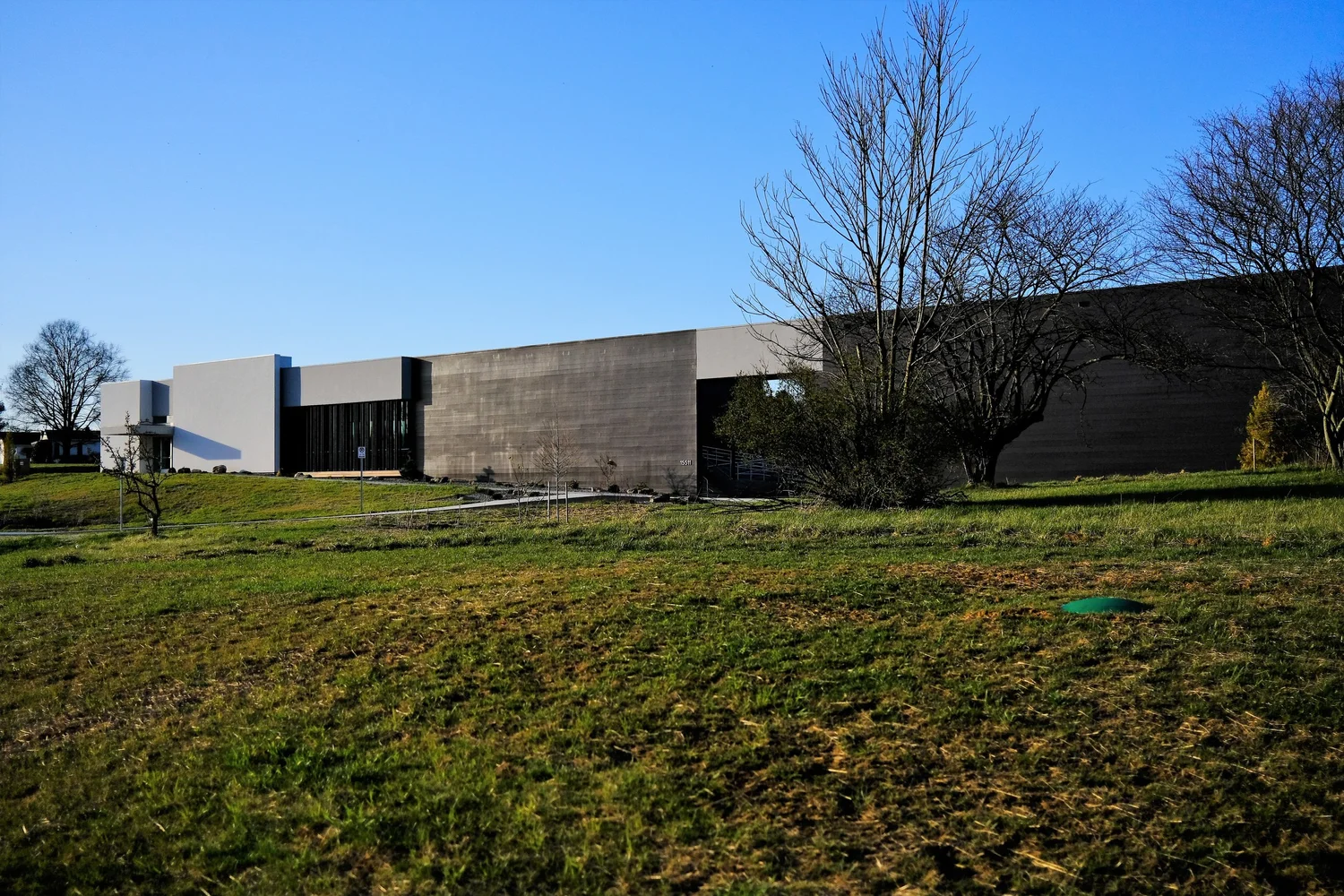
To “materialize” their goals of development, the USZI purchased a lot nearby in 2017.1 In 2020, construction began on the lot to build a rural retreat center—named the Amata Meditation Center. The center officially opened in 2022, along with “the enshrinement of a 2nd century Ghandara Buddha statue to mark the end of the construction process and the beginning of a new journey.”1 Currently, the Amata Meditation Center facilitates residential retreat and systematic doctrinal instructions.
The Amata Meditation Center comprises three buildings: the Main Hall, Exposition Hall, and Dormitory Hall.
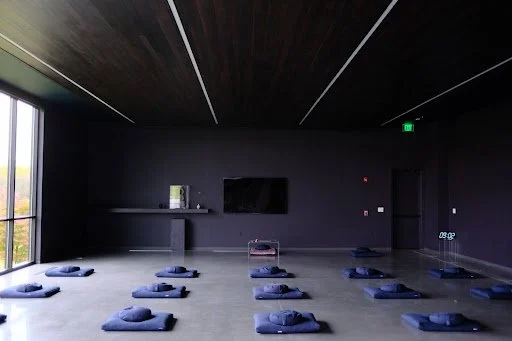
The Main Hall, designed to reduce outside noise, includes large indoor spaces for sitting and walking meditation, plus a lower-level classroom and kitchenette. Both levels open onto an outdoor-style zen garden.
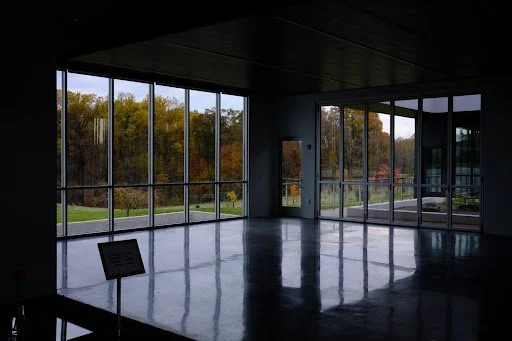
The Exposition Hall, adjacent to the Main Hall, provides an open area for social events and exhibitions.

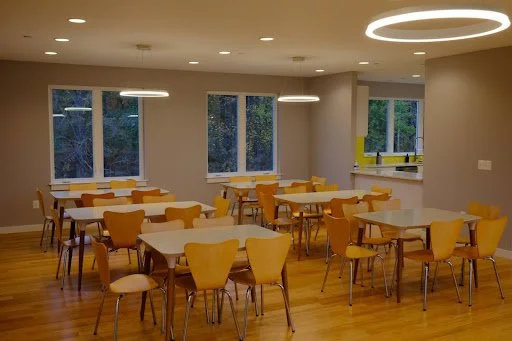
The Dormitory Hall, located behind the Main Hall, offers sleeping quarters on all levels, with a kitchen and dining area on the first floor and a laundry room in the basement.
Dhammadipa Sak

Dr. Dhammadipa Sak (Chinese: 法曜) is the Abbot and President of the USZI, along with its Amata Meditation Center. He also presides as Abbot at the Wisdom Temple in Billerica, Massachusetts and holds a position on the Board of Trustees of the Parliament of World’s Religions.
Dr. Dhammadipa Sak is a scholar of early Mahāyāna and Theravāda Buddhism with a focus on meditational techniques. His primary academic specialization lies in the studies of Sarvāstivāda Abhidharma and Theravāda Abhidhamma, along with “the Yogacāra system, especially Yogācārabhūmi, and Tientai, emphasizing the confluence of Śamatha and Vipaśyana in meditation theory.”4 Previously, Dr. Dhammadipa Sak’s published works touched upon many facets of Buddhism—from “The Divisions of anapanasati/smati in their Chronological Development” to “Guangzhou and its Role in Elite Buddhism during the Maritime Routes of the Six Dynasties.” His current research focuses on a “detailed exploration of Satipaṭṭhāna across different canonical sources” and “an exhaustive analysis of Buddha’s life,” according to Pali, Sanskrit, and Chinese canons.4
Following his birth to a Chinese family in Taiwan and upbringing in East Malaysia, Dhammadipa Sak received his monastic ordination in Sri Lanka in 1987. He earned a Bachelor’s degree in Buddhist Studies and Western Philosophy from the Pali and Buddhist University, along with a Master’s in Buddhist Philosophy from the University of Kelaniya. Dhammadipa Sak went to France to further his French and missionary works before moving to Taiwan to teach Early Buddhist philosophy and comparative Abhidharmas of two traditions at the Yuan Kuang Institute of Buddhist Studies and the Fuyen Buddhist Institute. After six years of research in the UK, Dhammadipa Sak received a Ph.D. from the Department of Religions at the University of Bristol. During his academic career, Dhammadipa Sak studied under several professors at Harvard University—gaining knowledge of different aspects of Buddhism in research fields such as Logic, Yogacāra, and anthropology. 5
Since 2008, Dr. Dhammadipa Sak had been affiliated with Sun Yat-sen University—first as a visiting professor of the anthropology and philosophy departments—and at present a research fellow. In 2019, he taught classes as a visiting professor at the University of Chicago, offering courses such as ‘The Foundation of Buddhist Thoughts’, ‘Comparative Reading of Pali and Chinese Buddhist Texts’, ‘Buddhist Scholasticism and Its Practice Structures’ and ‘Towards Ecumenical Buddhism’.4
Dr. Dhammadipa Sak’s previous religious roles include service as Abbot and resident monk at the Chuang Yen Monastery in Carmel, NY (2008-2015), followed by service at the Temple of Enlightenment in Bronx, NY until 2017. During his tenure in Taiwan (2020-2022), he established the Association of Sino Jhāyin, a body responsible for organizing an array of meditation retreats in Taiwan.
Currently, Dr. Dhammadipa Sak’s focus is on the Meditation Center Amata, “promulgating meditation techniques like Brahmavihāra bhavanā, Ānāpānasati/smṛti with regards to satipaṭṭhāna/Śmṛti-upasthāna, and Satipaṭṭhāna meditation methods.”4 He leads meditation retreats of varied durations globally and provides meditative instructions mostly on the Four Immeasurable Minds and partly on Mindfulness of Breathing and Insight Meditation.5 Under his position on the Board of Trustees of the Parliament of World’s Religions, Dr. Dhammadipa Sak strongly advocates for global religious unity and the promotion of ecumenical Buddhism. This is a result of “his years spent in Europe and the United States [that has] allowed him to understand the complexities of Buddhism in the West and in relation to Western culture, and the distinctive currents of beliefs and faiths in a changing global world.”5
Mission
“Our current objective, on the one hand, is to expand and enrich the existing programs in order to foster systematic understanding of Buddhism at the global level and, on the other hand, to engage in interfaith activities at the local level that intend to genuinely better the life quality of people in general and Buddhists in particular. We mean to keep in motion the globalization of Buddhism.”1
— U.S. Zen Institute
“Our mission is to promote long-term peace and well-being for all beings through the practice of samatha (concentration) and vipassana (insight) meditation. We strive to cultivate goodness in all people and to foster harmony across Buddhist lineages. Our meditation method is accessible to people of all religions, cultures, and nationalities, and we welcome everyone to learn and practice together in a diverse and inclusive community. “
— Amata Meditation Center
Schedule

The U.S. Zen Institute Temple holds weekly Sunday Group Chanting Sessions. Each Sunday of the month is assigned a specific Buddhist text or practice. During Sunday Group Chanting sessions, members of the community will usually wear a black robe, “which allows them to take on a more solemn understanding of the service.”2
Every Sunday, the Amata Meditation Center holds Sunday Meditation groups.
Otherwise, the center mainly focuses on facilitating meditation retreats, primarily offering courses in English:
3-Day Samadhi Meditation Retreat – No Prerequisites
For individuals who want to experience a meditation retreat, but are unable to commit to a full week-long immersion program. This retreat focuses on cultivating samadhi (concentration), which lays the groundwork for other meditation practices.
5-Day Loving-Kindness Meditation Retreat – No Prerequisites
Cultivates one of the Four Immeasureables: Loving-Kindness, the foundation for the Brahmavihara meditation technique.
8-Day Mindfulness of Breath Retreat – No Prerequisites
This retreat focuses on one of most common and popular meditation methods: Mindfulness of Breath (Anapanasati). By paying attention to your breath to attain samadhi (concentration), you are able to have a Nirvana-like experience.
8-Day Brahmavihara Meditation Retreat – No Prerequisites
Cultivates the Brahamavihara (Divine Abidings), also known as the Four Immeasurables: Loving-Kindness, Compassion, Sympathetic Joy, and Equanimity. At the Amata Meditation Center, meditating on the Four Immeasureables is considered the most crucial practice for all meditators. This retreat is a foundational course that serves as prerequisite for future retreats.
8-Day Satipatthana Meditation Retreat – Prerequisite: 2 Brahmavihara retreats
Cultivates on Satipatthāna (four establishments of mindfulness), also known as Insight Meditation—the practice of establishing right mindfulness to understand the nature of birth and death, impermanence, and the concept of non-self.
For more details, visit the Amata Meditation Center’s website. 8
Funding
The USZI is a religious non-profit organization with a recorded number of zero employees. The temple runs on volunteers and finances from funding from grants, donations, and fundraising efforts.9
The USZI’s most recent public tax filing record is dated in 2016, where the total revenue earned was $278,236 and the total expenses spent were $146,079.
The most recent grants from foundations and other non-profits to the USZI found in public records are as follows:
3/2024: $20,136 from American Online Giving Foundation
12/2023: $40,000 from Morgan Stanley Global Impact Funding Trust
6/2023: $6,400 from Charities Aid Foundation of America
Community and Constituency

As a nonsectarian non-profit organization, the temple welcomes “people from all over the world who are interested in Buddhism.”3 While most events held in the temple are in Chinese, they do provide some events in English and a Vietnamese contingent also often participates in mindful chanting retreats at the temple. The Amata Meditation Center, as mentioned above, offers its meditation retreats primarily in English.
The USZI has close ties with the local community—the temple itself was purchased and rebuilt from the efforts of the greater DC Asian community. During its early days, the founding nuns of the USZI temple ran the temple as close to the Taiwanese tradition as possible, hoping that the temple would bring Buddhism and Chinese culture back into the lives of Buddhists in America. They felt that “it was of great importance not to surrender strict adherence to tradition simply because it does not fit in with the mainstream American lifestyle.”2
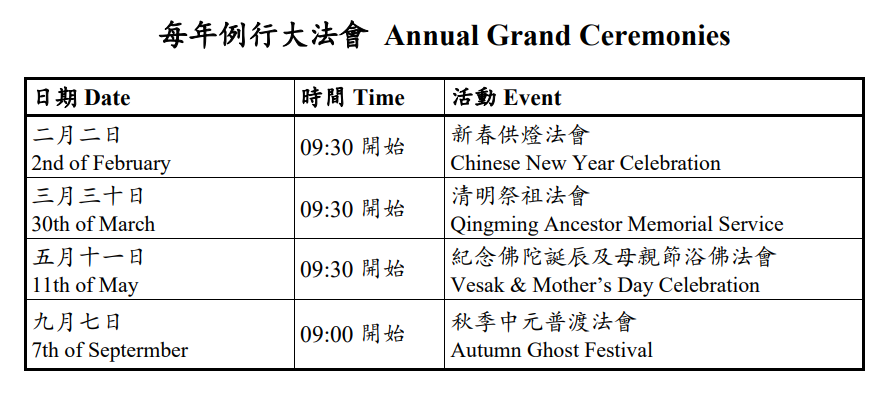
While there are no public statements from the current USZI under Dr. Dhammadipa Sak’s presidency using the same ideology, many of the Grand Annual Celebrations held at the temple closely resemble Taiwanese traditions rooted in Chinese culture. Additionally, the USZI and Amata Meditation Center still incorporates traditional Chinese characters in both its logo and websites—signifying that the temple’s loyal followers largely remain Chinese-speaking immigrants.
“The USZI fully recognizes the existing societal as well as global challenges posed by the ongoing globalization. We take it as a guiding principle for Buddhist organizations such as the USZI to work hand in hand with all other faiths in addressing these issues in the long term.”3
—U.S. Zen Institute
Additionally, the USZI annually participates in the International Vesak festival for all the Buddhist communities and centers in Washington DC.2
There are no public records of the USZI’s constituency statistical information regarding member numbers and demographics. However, based on its location in “a residential neighborhood of suburban Washington DC next to the Germantown MARC light rail station closer to newer Asian areas of Maryland such as Rockville and Gaithersburg,”1 as well as the continuous financial support it receives from the Asian immigrant community, it can be inferred that the demographic of the USZI Temple are largely immigrant Asian Americans in the DC Area.
Published December 1st, 2025
By Sherry Zhang

Citations
- “American Chinese Buddhist Temples in the USA.” San Francisco Bay Area Buddhism, www.sfzen.org/all-other-usa-american-chinese-buddhist-temples#DC.
↩︎ - “U.S. Zen Institute: Pluralism Project Archive.” Harvard University, pluralismarchive.hsites.harvard.edu/us-zen-institute.
↩︎ - “美國禪學講堂 US Zen Institute.” US Zen Institute, uszen.org.
↩︎ - “法曜法師 Ven. Dr. Dhammadipa Sak, Ph.D.” Amata Meditation Center, https://amata.global/dhammadipa. ↩︎
- “Venerable Dhammadipa Sak.” American Wisdom Association,
https://wisdom-temple.org/en/venerable-dhammadipa-sak/. ↩︎ - “Venerable Dhammadipa Sak.” American Wisdom Association,
https://wisdom-temple.org/en/venerable-dhammadipa-sak/. ↩︎ - “Venerable Dhammadipa Sak.” American Wisdom Association,
https://wisdom-temple.org/en/venerable-dhammadipa-sak/. ↩︎ - “Amata.” Amata Meditation Center, https://amatavihara.org/. ↩︎
- “U S Zen Institute.” Cause IQ, https://www.causeiq.com/organizations/u-s-zen-institute,521579053/ ↩︎
- “The Rabbit’s Horn: going across Buddhist America with an open mind, a warm heart, and a cheap camera.” The Rabbit’s Horn, https://rabbitshorn.wordpress.com/location/washington-dc-area/
↩︎