Written by Samantha Danker
The Awam Tibetan Buddhist Institute in Tucson, Arizona is a community of non-monastics who are committed to liberation and compassion. This community, founded in 2000, follows the Nyingma tradition and offers teachings ranging from basic mindfulness to Dzogchen (Great Perfection) practices. “Awam” translates to “such” or “this,” but it represents the necessary collaboration between the female principle (“A”) of compassion and the male principle (“wam”) of wisdom to reach enlightenment. They believe in the Tibetan Vajrayana principles of equanimity and great compassion, as shown by this phrase on their website; “May all beings abide in peace, calm, and contentment with lovingkindness, compassion, and altruistic generosity for all.”

Awam Tibetan Buddhist Institute logo (Credit: The Official Website of HH Khenchen Lama Rinpoche)
Founder
Khenchen Lama Rinpoche founded the Awam Tibetan Buddhist Institute in 2000. Outside of Arizona, he has also created Awam Centers in Slovenia, Australia, Tibet, and China. At a young age, Rinpoche was recognized as the reincarnation of Padma Dagnag Lingpa, who was a reincarnation of one of Padmasambhava’s closest disciples. This made Rinpoche the current head of the Padling Tersar lineage. His education has been rigorous in his study of Buddhism that spans Nyingma, Sakya, Kagyu, and Geluk while working with many Buddhist masters. He studied in both Sutra and Tantra at Ahrik University and Larung University. Included in his training was three months of silent solitary retreat each year, totaling to about four years worth of time spent in retreat. His commitment to mindfulness leads him to heavily emphasize the importance of meditative practice in his teachings. For his educational achievements and dedication, he holds the titles of Khenpo and Khenchen from Ahrig University’s Great Buddhist Institute for Higher Learning in Tibet, making him a high-ranking and accomplished Buddhist leader.
Now, Rinpoche is known as a master of dream yoga and a devout meditation practitioner. In addition to teaching at various monasteries and Buddhist centers, he supports an orphanage he founded in Tibet that provides accommodations and education for 150 children. To support this cause, Rinpoche’s students at Awam in Tucson started the Awam Foundation, a non-profit that raises money for the orphanage. Rinpoche is the spiritual director of The Awam Tibetan Buddhist Institute in Tucson, and the other Awam Centers, and helps lead the Awam Foundation.

Khenchen Lama Rinpoche in Singapore on his 2024 teaching tour (Credit: The Official Website of HH Khenchen Lama Rinpoche)
Practices and Community
The Awam Tibetan Buddhist Institute solely serves laypeople, which they refer to as householders, who have families and other commitments. They offer a variety of in-person and online classes, as well as course videos that can be found on Youtube. In-person classes are recommended for serious students because the teachers can provide personal guidance. Online classes can be taken at any time, and the practitioner decides the pace with which they move through the course. There are eight Essentials of Tibetan Buddhism courses that cover the Middle Way, history of Buddhism, generation and completion stage yoga, and mandala offerings. These courses include the Paths of Individual Liberation, Altruism, Tantra, and Great Perfection. The basic classes serve as prerequisites for the advanced classes, like courses on Dzogchen and the Sutras.
Outside of the classes, there are other opportunities for the community to gather. A weekly meditation hour is offered on Sundays with preliminary meditative practices and prayers for all who want to join. There’s also a Wednesday mindfulness practice to help participants calm their minds and exercise techniques that they can use to maintain this mindfulness in their lives outside Awam. Currently, the Wednesday class is focused on the Four Jhanas. The community also celebrates Tibetan holidays, like Losar and the Four Great Festivals. Losar is the first day of the new year on the Tibetan Lunar Calendar. This holiday is typically celebrated for a week including prayers, blessings, special food, dancings, and songs. However, these traditions cannot be fully observed in Tibet due to the Chinese occupation. The Four Great Festivals are four holy days throughout the year that commemorate different parts of the Buddha’s life. Events like these are important for building a community that’s committed and supportive.
All of Awam’s classes and videos are free to give everyone access to the teachings, regardless of their level or financial situation. Since they don’t charge for their classes, all of their funding comes from donations. Everyone working at the institute is a volunteer, so donations go to support Awam programs and operating expenses, like rent and utilities. Donations to the Awam Tibetan Buddhist Institute can be made from their website, and people can donate online to Rinpoche’s Awam Foundation to benefit Rinpoche’s orphanage.
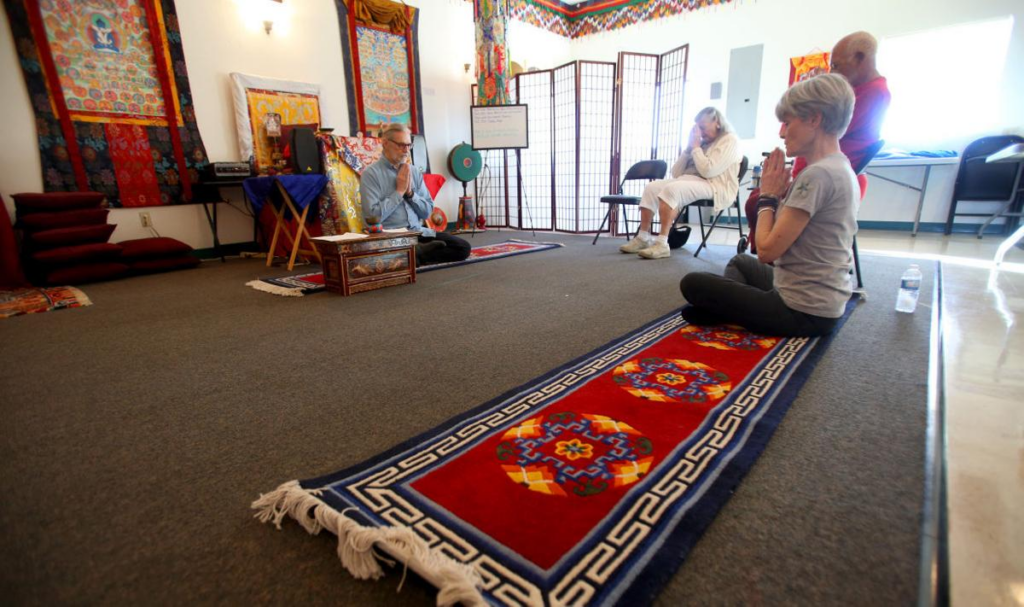
Khenchen Drimed Dawa, the main teacher at Awam, with practitioners (Credit: Awam Tibetan Buddhist Institute hosts weekend of teaching)
Relationship with Other Communities
Tucson, like the rest of Arizona, has a small Buddhist community. According to a 2023-24 Pew Research study, 2% of adults in Arizona identify as Buddhists, which is similar to the prominence of Buddhism in California and Oregon. Tucson is the second largest Arizona city with a population of 1.5 million in the city and metropolitan area. There are roughly 10 Buddhist centers to serve this population that vary in sect and degree of traditionalism. It appears the Awam Tibetan Buddhist Institute falls in the middle of this spectrum.
The non-traditional aspects of Awam are not difficult to spot in the practices. The classes, videos, and readings are all in English, and the ordained head teacher, Khenchen Drimed Dawa, is white. Also, Awam is closed for holidays like Thanksgiving and Christmas. However, Awam maintains traditional Nyingma teachings and focuses. For example, they believe in practicing to achieve liberation in this lifetime. Their courses explicitly include traditional Nyingma ideals, such as the Bodhisattva path, bodhicitta, generation stage and completion stage practices, the bardos, and Great Perfection. While they do offer a mindfulness course that solely focuses on meditation without textual study, Awam balances meditative practice with textual study and cultural understanding. This is in contrast with many American meditation centers that are based in Buddhism, but avoid any overtly Buddhist language and simply focus on meditation.
Awam’s connection to Buddhist centers in other countries and the orphanage in Tibet ensures collaboration between communities and mutual support. This is especially true because these centers are all directed by Rinpoche and share the Awam Center name. Additionally, Khenchen Drimed Dawa tried to improve cooperation within the Tuscon Buddhist community by creating a website that provides information about all the Buddhist organizations in the area. The website made information about the groups easily accessible for potential customers and practitioners. It also allowed the organizations to learn more about each other and identify similarities and differences between them. The website itself is no longer active, but the database is now a part of Awam’s website. It can be seen here, but it’s important to note that it hasn’t been updated since May 2023.
Overall, the Awam Tibetan Buddhist Institute is a welcoming community with practitioners who are eager to share the teachings with anyone who is open to learning. Awam’s classes are easily accessible, free, and led by qualified teachers to provide personal guidance. Members aspire to achieve liberation in this lifetime, and they believe in both textual and meditative study. The blend between traditional and non-traditional components makes Awam a Buddhist center that fits with Western culture while giving practitioners a well-grounded Nyingma training.
Sources
Awam Tibetan Buddhist Institute, https://www.awaminstitute.org/. Accessed 26 November 2025.
The Official Website of His Holiness Khenchen Lama Rinpoche –, https://khenchenlama.com/. Accessed 29 November 2025.
“Arizona Cities by Population 2025.” World Population Review, https://worldpopulationreview.com/us-cities/arizona. Accessed 29 November 2025.
“Awam Foundation.” Awam Tibet, https://awamtibet.org/awam-foundation/. Accessed 26 November 2025.
“A brief introduction to Losar, Tibetan New Year.” Central Tibetan Administration, https://tibet.net/a-brief-introduction-to-losar-tibetan-new-year/. Accessed 29 November 2025.
“Community Analysis.” Tucson Bike Share Feasibility Study, https://www.tucsonaz.gov/files/sharedassets/public/v/1/transportation-and-mobility/documents/tucson_community_analysis_attachment.pdf. Accessed 26 November 2025.
“People in Arizona | Religious Landscape Study (RLS).” Pew Research Center, https://www.pewresearch.org/religious-landscape-study/state/arizona/. Accessed 29 November 2025.
“Vision, Mission, and Philanthropy of Awam Tibetan Heart Center.” Awam Tibetan Heart Center, https://awamtibetanheartcenter.org/. Accessed 29 November 2025.
Willett, Johanna. “Online list of Buddhist groups to promote collaboration.” Arizona Daiy Star, 2 February 2018, https://tucson.com/lifestyles/faith-and-values/article_961106b6-7e7f-5689-839b-2da999ccad02.html. Accessed 26 November 2025.