History, Founding, and Founders
The Dharma Rain Zen Center, a Soto Zen Buddhist community located in Portland, Oregon, was founded in 1986 by Kyogen and Gyokuko Carlson.
What is now the official Dharma Rain Zen Center began in the training monastery, Shasta Abbey. Located in Mt. Shasta, California, Shasta Abbey was established by Roshi Jiyu Kennett, an Englishwoman who converted to Zen Buddhism after meeting Zen teacher Keido Chisan in 1960. Keido Chisan died in 1967, and in 1970, Roshi Kennett began teaching Soto Zen and established Shasta Abbey.
In 1974, two college students -Andrea Kroenke and Gary Carlson- sought spiritual refuge at Shasta Abbey. They were ordained and given the Dharma names Gyokuko and Kyogen, respectively. A Dharma name is a sacred name given to Buddhist students upon initiation. Together, the newlywed resident priests – married in 1982 – of the Oregon Zen Priory split from Shasta Abbey and established the Dharma Rain Zen Center in 1986, carrying forth the Dharma (teachings) they learned from Roshi Kennett for nearly thirty years.
Soto Zen | Asian Buddhsim
Roshi Kennett emphasized awakening, monastic practice, intense student-teacher relationships, and precepts or ethical conduct.
In Soto Zen – one of two Japanese sects of Mahayana Buddhism (Pure Land and Zen) – awakening is commonly understood among Buddhists as the realization of one’s inherent Buddha-nature. On the other hand, Pure Land Buddhism emphasizes enlightenment through faith in Amitabha. Buddha nature is the innate ability in all sentient beings to attain enlightenment. The Soto Zen tradition emphasizes seated, silent meditation – meditating without a goal. Seated, silent meditation is also called “Zazen.” In silence and without a goal, meditators recognize their inherent Buddha nature; note that nirvana cannot be logically explained or understood.
According to Dharma Rain’s Vision, they seek to “relieve suffering by the skillful use of Buddhist teachings and generous acceptance of all beings.” Indeed, compassion for all sentient beings and acceptance are central to awakening – core Mahayana Buddhist principles.
Practices and Scheduled Activities
From introductory Zen meditation practices to Zen poetry and Dharma song sing-alongs, the Dharma Rain Zen Center offers a variety of scheduled practices and activities. In November, the most frequently offered activity is the “Ango Morning Program” from 5:30-7:45 a.m. from Wednesday through Saturday. In Japanese, “Ango” refers to peaceful dwelling. And in many meditation traditions, dawn and dusk are most conducive for meditation.
Perhaps most intriguing is the Rohatsu Sesshin (retreat), which commemorates the Buddha’s enlightenment on December 8th, and spans eight days – from December 7th to December 14th. Among all Dharma Rain’s offered retreats this year, Rohatsu Sesshin is the “longest and most intense.”
Constituency and Funding
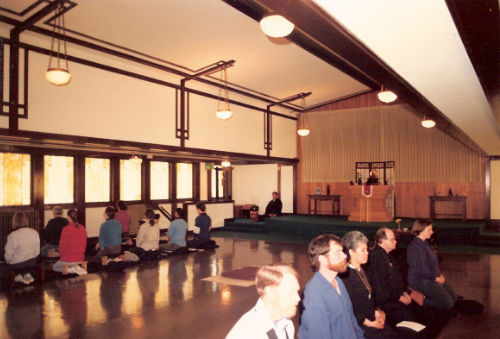
No information is available regarding the constituency of Dharma Rain. The website does, however, feature images of meditators, as well as links to youth and family programs. The images display mostly Caucasian adults, both men and women, and Dharma Rain is open to people of all ages.
Dharma Rain is funded by three sources of income: monthly membership dues, retreat and event fees, and charitable donations. For as low as $15/month, those who wish to join Dharma Rain receive all the membership benefits. To name a few, benefits include reduced fees for events, library book check-out, and access to participate in exclusive membership programs. Additionally, membership labels differ in how much the member donates. Donors who contribute more than $200/month are “Benefactors.” Donations help cover free classes and workshops, basic utility costs, and the salaries of monastic staff who serve the temple.
References:
- “History of Dharma Rain Zen Center”
- https://dharma-rain.org/about/history-of-dharma-rain/
- “Our Mission and Vision”
- https://dharma-rain.org/about/our-mission-and-vision/
- “Soto Zen”
- https://www.szba.org/introducing-soto-zen
Written by Nikita Kobzar