

- Garchen Rinpoche – retrieved from DDSC website
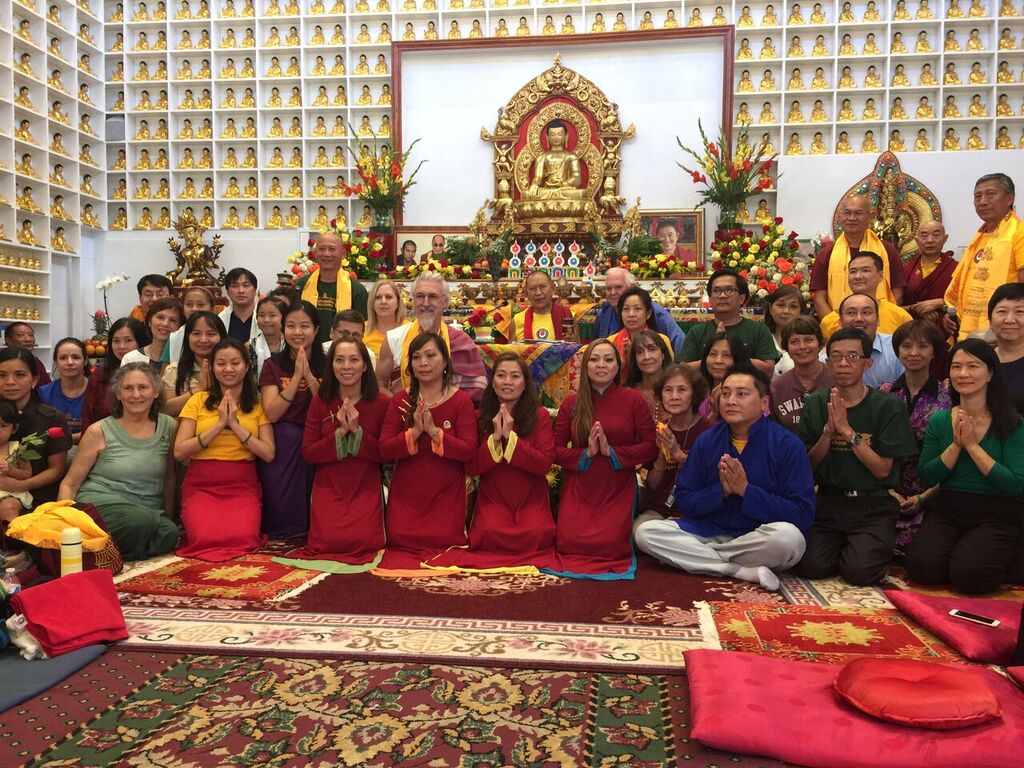
 On a larger scale, relics are also attainable through making donations. DDSC offers treasure vases and Jigten Sumgon statues that are blessed by Garchen Rinpoche and filled with sacred relics, healing substances and rare elements. Larger donations can also be made in the name of sponsoring one of the 1,000 Buddha statues lining the walls of the shrine room. For $1,000, one can sponsor a Buddha statue and have his name on a plaque below that statue. Sponsorship of a statue is a way to gain good karma that could bring one fortune in this life as well as the next.
I visited DDSC on November 28th. As I pulled up in front of the temple, a monastic-looking man in a grey tracksuit was pacing slowly near the entrance. Only later when I had left the center did I realize that that was Khenpo Samdup himself. By the door was an overflowing shoe cabinet, indicating some event taking place. Sure enough, in the first room, there was a long table where some children sat, dabbing colored sand on paper with simple patterns on it. It was Tibetan art workshop day, where visitors could experience traditional Tibetan crafts like butter sculpture figures and sand painting of Tibetan motifs.
On a larger scale, relics are also attainable through making donations. DDSC offers treasure vases and Jigten Sumgon statues that are blessed by Garchen Rinpoche and filled with sacred relics, healing substances and rare elements. Larger donations can also be made in the name of sponsoring one of the 1,000 Buddha statues lining the walls of the shrine room. For $1,000, one can sponsor a Buddha statue and have his name on a plaque below that statue. Sponsorship of a statue is a way to gain good karma that could bring one fortune in this life as well as the next.
I visited DDSC on November 28th. As I pulled up in front of the temple, a monastic-looking man in a grey tracksuit was pacing slowly near the entrance. Only later when I had left the center did I realize that that was Khenpo Samdup himself. By the door was an overflowing shoe cabinet, indicating some event taking place. Sure enough, in the first room, there was a long table where some children sat, dabbing colored sand on paper with simple patterns on it. It was Tibetan art workshop day, where visitors could experience traditional Tibetan crafts like butter sculpture figures and sand painting of Tibetan motifs.

 To the left of the main room was the glittery “gift shop”. At the right end of the room was a door that opened up to a large meditation room. The front part of the room contained the shrine, where the walls are lined with Buddha statues. The second half of the room had paintings of Buddhist masters in history. The whole room is brightly lit by natural sunlight filtering through skylights that take up almost the entire slanted ceiling.

 The room is silent except for the rhythmic scratching of Chak-purs, the cone-shaped tools used to create sand mandalas. Here four monks sit around a real sand mandala. A traditional Tibetan artwork, sand mandalas are created to resemble a Buddhist map of our world and destroyed to symbolize the non-permanent nature of this world. When I visited, the mandala was close to completion, with the dispersion ceremony scheduled for the next day. The layering sounds of Chak-purs echoed through the empty room, occasionally rising up in volume as the four layers come together to resonate.
When I inquired about the administration of this center, I was introduced to Brian, a Taiwanese immigrant who helped running the center. All administrators are lay people, and the monks only focus on teaching and meditation. Although run almost exclusively by immigrants born in Asia, the center has almost as many American members as immigrant members. “Among the immigrant constituents, the composition is very international”, Brian said as he showed me what he was working on. It was a design of program hand-outs for their next event. “Most other temples only need two languages, maybe three at most. But we need so many! Tibetan, Vietnamese, Chinese, English… I have to put all of them on here,” he laughed.
The room is silent except for the rhythmic scratching of Chak-purs, the cone-shaped tools used to create sand mandalas. Here four monks sit around a real sand mandala. A traditional Tibetan artwork, sand mandalas are created to resemble a Buddhist map of our world and destroyed to symbolize the non-permanent nature of this world. When I visited, the mandala was close to completion, with the dispersion ceremony scheduled for the next day. The layering sounds of Chak-purs echoed through the empty room, occasionally rising up in volume as the four layers come together to resonate.
When I inquired about the administration of this center, I was introduced to Brian, a Taiwanese immigrant who helped running the center. All administrators are lay people, and the monks only focus on teaching and meditation. Although run almost exclusively by immigrants born in Asia, the center has almost as many American members as immigrant members. “Among the immigrant constituents, the composition is very international”, Brian said as he showed me what he was working on. It was a design of program hand-outs for their next event. “Most other temples only need two languages, maybe three at most. But we need so many! Tibetan, Vietnamese, Chinese, English… I have to put all of them on here,” he laughed.
- Retrieved from DDSC website
 With Brian I discussed the teachings and general beliefs of DDSC, which follows closely to the teachings of the Kagyu Lineage. Part of the Mahayana tradition, the Kagyu lineage believes in multiple Buddhas. When one completes the ten Bodhisattva stages and reaches enlightenment, he or she can choose to enter Nirvana, or remain in Samsara as a Bodhisattva.In the picture on the right, the statue on the far left with four arms is of Chenrezig, or Avalokiteśvara, who is a
  Bodhisattva believed to have reached enlightenment before Shakyamuni. Yet he chose to remain in Samsara due to great compassion for sentient beings. Tibetan Buddhists believe that Tara is a manifestation of Chenrezig’s compassion. Monks here also believe in the supernatural aspects of Buddha’s life. Brian cited a story where Buddha took a sip of water and said: “I have just drank countless sentient beings”, which referred to the germs and bacteria present yet undiscovered at the time. But Buddha knew they were there. Jataka tales are taught in classes because they convey important lessons regarding the essence of Buddhism. However, the monks do not teach the supernatural aspects of Buddha’s story, for it may cause confusion to students. The monks do not want the idea of potential superpowers to blind the students to what is truly important.
Brian did not think of Buddhism as a religion, because everything is up to the person himself. Teachers cannot truly teach Buddhism, but rather guide people to find the essence themselves. Lessons and rules can only go so far; inner development is what matters. Therefore there are no strict rules prohibiting a person on the path to enlightenment. For example, Buddhists are not supposed to smoke for it introduces unclean air into their bodies. Yet if someone were to smoke, no one should condemn him for it. Perhaps trying to compare Buddhism to Christianity, he also referenced sexual orientation, which in his opinion is perfectly acceptable for any orientation because “you choose who you love and there is nothing wrong with that. You have love, and that’s good.” Ultimately, compassion is the one core value to a true Buddhist.
I left the temple, bid goodbye to the monk in the grey tracksuit, who closed his hands together and bowed lightly in return, and I still had no idea that he was the resident lama. I drove away, taking in my last sight of the small fragment of Tibetan Buddhism that traveled all the way to suburban Northern Virginia, hidden behind trees on the side of a busy road. Colorful prayer flags stretched across the side of the building added to the mystical exotic texture of the scenery, and then it was gone.
Bodhisattva believed to have reached enlightenment before Shakyamuni. Yet he chose to remain in Samsara due to great compassion for sentient beings. Tibetan Buddhists believe that Tara is a manifestation of Chenrezig’s compassion. Monks here also believe in the supernatural aspects of Buddha’s life. Brian cited a story where Buddha took a sip of water and said: “I have just drank countless sentient beings”, which referred to the germs and bacteria present yet undiscovered at the time. But Buddha knew they were there. Jataka tales are taught in classes because they convey important lessons regarding the essence of Buddhism. However, the monks do not teach the supernatural aspects of Buddha’s story, for it may cause confusion to students. The monks do not want the idea of potential superpowers to blind the students to what is truly important.
Brian did not think of Buddhism as a religion, because everything is up to the person himself. Teachers cannot truly teach Buddhism, but rather guide people to find the essence themselves. Lessons and rules can only go so far; inner development is what matters. Therefore there are no strict rules prohibiting a person on the path to enlightenment. For example, Buddhists are not supposed to smoke for it introduces unclean air into their bodies. Yet if someone were to smoke, no one should condemn him for it. Perhaps trying to compare Buddhism to Christianity, he also referenced sexual orientation, which in his opinion is perfectly acceptable for any orientation because “you choose who you love and there is nothing wrong with that. You have love, and that’s good.” Ultimately, compassion is the one core value to a true Buddhist.
I left the temple, bid goodbye to the monk in the grey tracksuit, who closed his hands together and bowed lightly in return, and I still had no idea that he was the resident lama. I drove away, taking in my last sight of the small fragment of Tibetan Buddhism that traveled all the way to suburban Northern Virginia, hidden behind trees on the side of a busy road. Colorful prayer flags stretched across the side of the building added to the mystical exotic texture of the scenery, and then it was gone.