“Gift of Life”
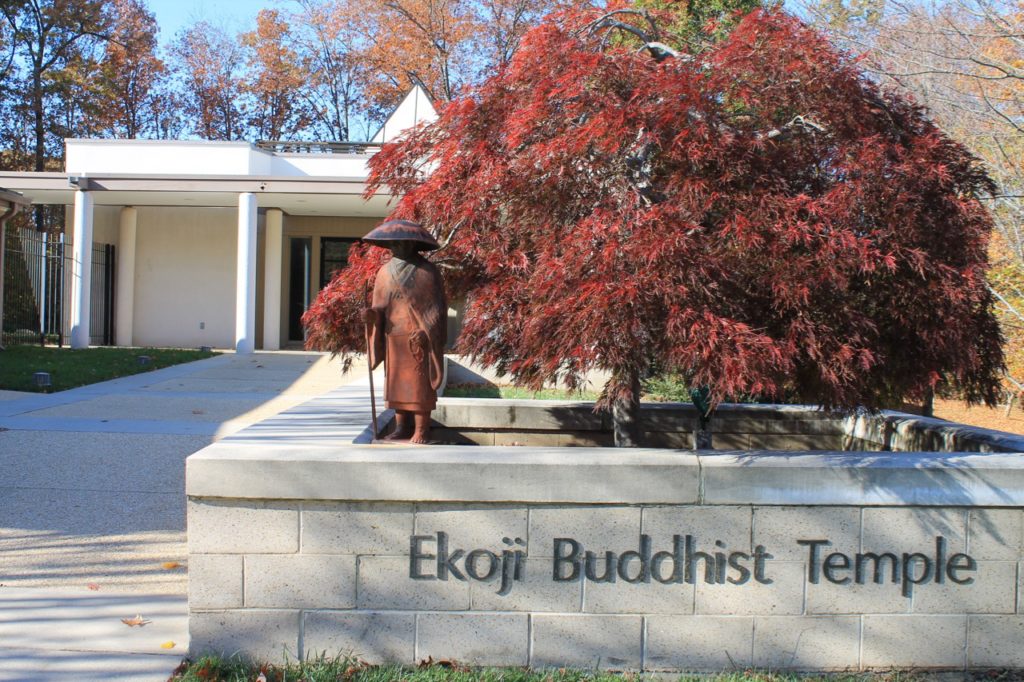
Located in the suburbs of Fairfax Station, Virginia, the Ekoji Buddhist Temple has grown from a small Dharma school for Shin Buddhist families into a diverse community. Ekoji , meaning “Temple of the Gift of Light,” references the teachings of the Buddha as a gift of light and wisdom, specifically within Jōdo Shinshū and Pure Land Buddhism.
Origins
Ekoji was founded on November 8, 1981 by Rev. Kenryu Tsuji and Rev. Dr. Yehan Numata, who wanted to create a Buddhist community serving the spiritual needs of families in the Washington, D.C. area. Rev. Kenryu Tsuji was one of the earliest Jōdo Shinshū ministers active in the U.S. and helped expand the Buddhist Churches of America (BCA) beyond Japanese immigrant communities. Rev. Dr. Yehan Numata, one of the founders the Buddhist publishing group Bukkyō Dendō Kyōkai (BDK), envisioned Buddhism becoming a part of American religious life. He had pushed to have services in English, education for non-Japanese audiences, and engagement across different faiths. When both Rev. Tsuji and Numata founded Ekoji temple, they did so based on their experiences as Buddhists in America. The temple helps continue a U.S. specific version of Pure Land Buddhist teachings.
It is imperative that when looking at Ekoji temple and its development, we also look at the larger historical context of Japanese American Pure Land Buddhism. Jōdo Shinshū arrived in the U.S. in the late 19th century alongside many Japanese immigrants relocating to the West Coast. Temples served as meeting points for these displaced and uprooted communities. However, during World War II, many Japanese American Buddhists were jailed and the practice of Buddhism was labeled as “foreign.” In the postwar period, many scholars documented that Shinshū Buddhism had to adopt American religious aspects, such as Sunday services, youth programs, and English services, in order to survive. Ekoji Buddhist Temple, founded decades later, is a direct product of this adaptation.
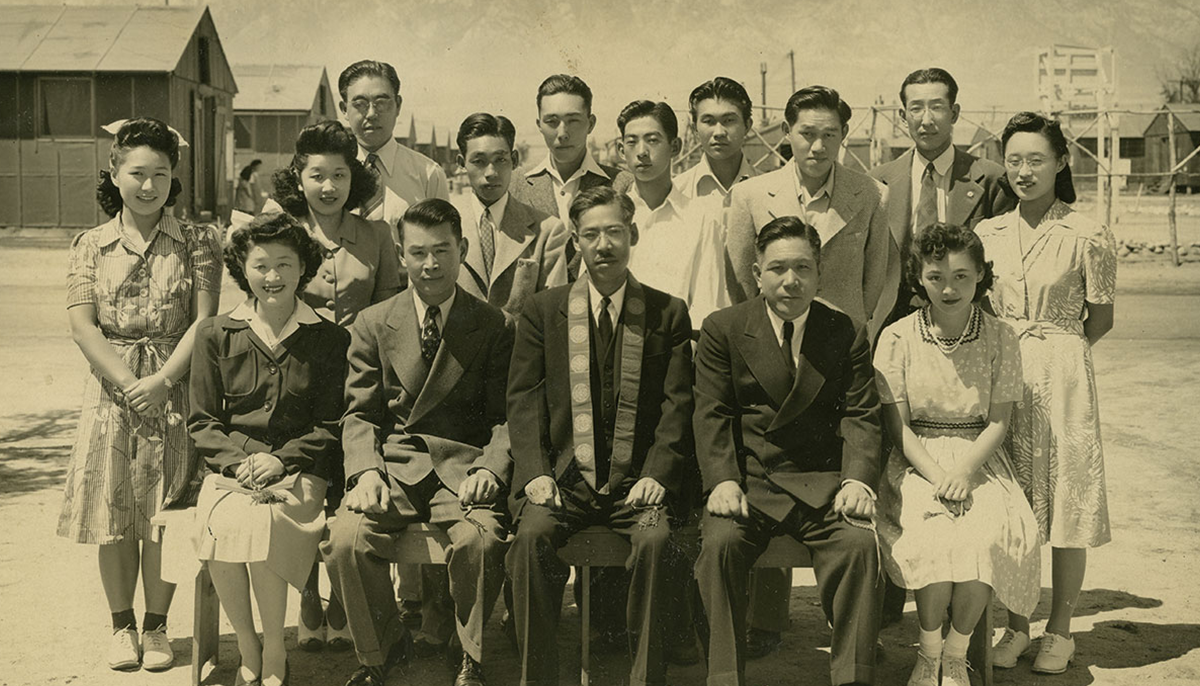
Japanese Americans in an internment camp, CA 1943
Affiliated Tradition and Other Buddhist Communities
Ekoji practices Jōdo Shinshū, which is the largest school of Japanese Pure Land Buddhism. Shinshū, founded by Shinran Shonin, has one primary practice known as the Nembutsu, or the recitation of “Namu Amida Butsu.” This is an expression of gratitude and not a method of achieving enlightenment. At Ekoji temple, these Shinshū ideas and many more are adapted to modern American religious life.
Ekoji is a member of BCA, one of the oldest Buddhist organization in the U.S. Because of this, it is connected to over sixty Shinshū temples across the U.S. BCA is affiliated with the Nishi Hongwanji branch of Jōdo Shinshū in Kyoto, which offers training for ministers, religious materials, and doctrinal advice. Ekoji participates in BCA conferences, retreats, and children’s programs and is also involved with local Buddhist groups in the Washington, D.C. area. This work allows Ekoji to connect both with Asian American religious networks and broader American convert Buddhist communities.
Community and Happenings
Originally the congregation met in a small building in Springfield, Virginia, but over the years as the community grew, they expanded into the current building. The services and programs are offered in English and live-streamed which allows the Temple to be accessible to many different communities and encourages inclusivity. Exact numbers are not publicly listed on the website, however the temple’s Facebook and other social media appears to support dozens of active members. There appears to be significant participation in cultural events and festivals.
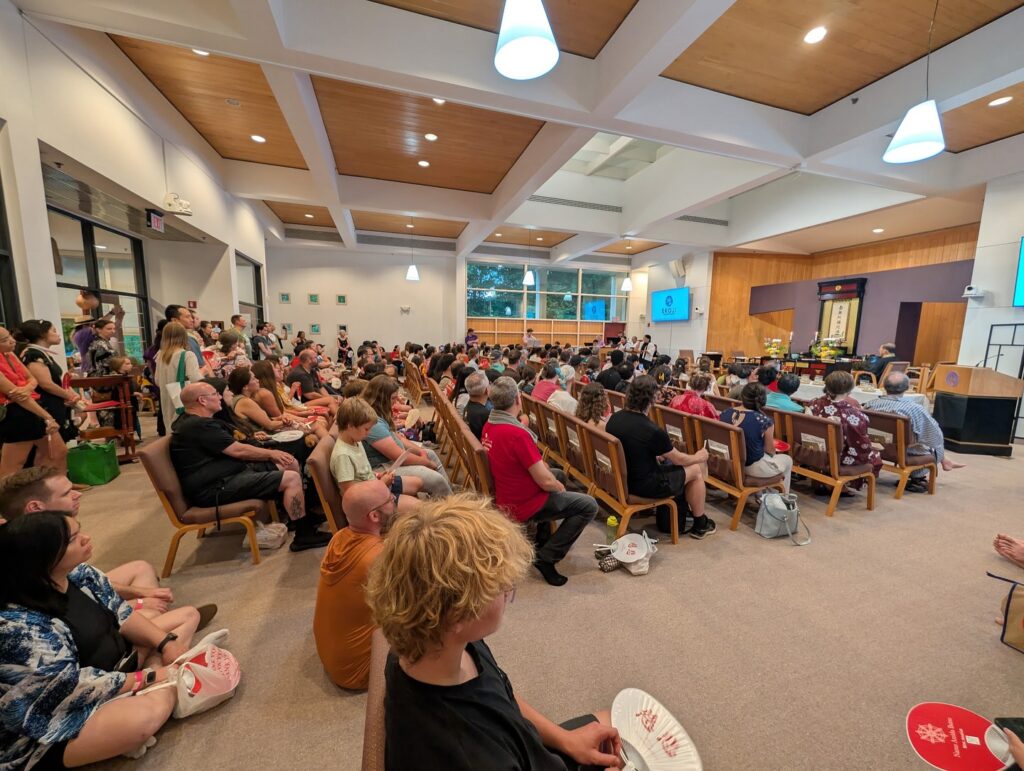
- Sunday Services — Every Sunday, Ekoji holds a Jōdo Shinshū service in English led by the current supervising minister, Rev. Kurt Rye. The sermon involve chanting sutras, recitation of the Nembutsu, singing of a gatha, Dharma talks, and community time.
- Monthly and Special Services — Ekoji holds “Shotsuki” memorial services at 11am on the first Sunday of the month “in memory of our loved ones whose date of death falls in that month.” Family and friends are invited to offer incense, Oshoko, during the chant “Juseige.” Additionally, the temple offers “Osaji” services at 10am monthly on the 16th to honor their founder, Shinran Shonin. The website describes that during this service “We chant the ‘Shoshinge’ offer incense, and sit in quiet reflection.” Services for children and families at the Dharma School are also offered.
- Thursday Meditation Sessions — A regular meditation session is held on Thursdays at 8pm in the Hondo building and includes a short sutra chant, a 10 minute walking meditation, and a longer silent or guided mediation session. These sessions are often followed up by discussion and tea.
- Community and Cultural Events — The temple hosts an annual arts fair and cultural festivals.
- Nen Daiko — Taiko Drumming Ensemble: One of the most notable aspects of Ekoji is its taiko-drumming group Nen Daiko, founded in 1994. Nen Daiko performs publicly at cultural festivals, national events, and at Ekoji’s festival of Obon.
- Obon Festival — Their Obon festival is a summer festival that combines folk dance (Bon Odori), taiko performance, and an evening candlelight memorial. This festival allows Buddhism and modern American life to intersect.
Funding
Ekoji temple is funded through donations, fundraisers, and community proceeds. Additional support comes from BDK due to its relationship with Rev. Dr. Yehan Numata, and from BCA. Many temples also rely on volunteer work for festivals and events, so it can be assumed Ekoji also follows this structure.
Ekoji and American Buddhism
According to Ekoji’s mission statement, the temple strives to “provide a place where all people can learn, practice, and share the Buddha Dharma.” Members therefore understand their practice as a reflection of Shinshū Buddhism and its values such as “humility, awareness, and deep gratitude,” as outlined by the BCA. The temple’s website also states that they welcome “everyone regardless of background,” helping members see themselves as part of a large, diverse Buddhist community. Similarly, the BCA describes its temples as “bridges between Japanese American heritage and the wider American Buddhist landscape,” which aligns with Ekoji’s methods of incorporating English services, meditation services and community events
Ekoji Temple functions as both a religious institution and community center. It serves as a perfect example of how Asian Buddhist traditions can take root, adapt, and thrive in an American context. It is specifically tailored to the diversity and resilience found in our country’s Buddhist communities. U.S. Pure Land Buddhism found root in Japanese immigrant communities in the late 19th-20th century and has expanded due to American converts. It is characterized by a hybrid religious ethnic identity and tailored towards American religious pluralism. Ekoji Temple demonstrates this unique form of Pure Land Buddhism that has the ability to adapt to its community members and the society around it. Ekoji includes dharma talks, meditation sessions, and designated community time showing how Shinshū Buddhism can fit into everyday life with an emphasis on interconnectedness. The temple translates Japanese Pure Land teachings into multicultural and interfaith settings. In this way, Ekoji serves as a way to preserve and maintain Japanese American heritage while welcoming people of all backgrounds.
Report by Corinne Boyd
Works Cited:
Buddhist Churches of America (BCA). History and Mission, Buddhist Churches of America, https://www.buddhistchurchesofamerica.org/history-and-mission
Bukkyo Dendo Kyokai (BDK). About BDK, BDK America, https://bdkamerica.org/about-bdk
Cadge, Wendy. Heartwood: The First Generation of Theravada Buddhists in America. University of Chicago Press, 2005
Dobbins, James C. Jōdo Shinshū: Shin Buddhism in Medieval Japan. Indiana University Press, 2002
Ekoji Buddhist Temple. About Ekoji, Ekoji Buddhist Temple, https://ekoji.org/about
Ekoji Buddhist Temple. Facebook Page, https://www.facebook.com/EkojiBuddhistTemple/
Han, Chenxing. Be the Refuge: Raising the Voices of Asian American Buddhists. North Atlantic Books, 2021
Hsu, Funie. “‘We’ve Been Here All Along’: The Struggle for Visibility and the Search for Home in Asian America and American Buddhism.” Lion’s Roar, 2 Feb. 2016, https://www.lionsroar.com/weve-been-here-all-along/
Matsubara, Hiroko. Review: American Sutra: Buddhism and Pure Land Adaptation Among Japanese Americans. University of Hawai‘i Press, 2009
Nattier, Jan. “Buddhism Comes to America.” The Wilson Quarterly, vol. 21, no. 2, 1997, pp. 72–80
Unno, Taitetsu. River of Fire, River of Water: An Introduction to the Pure Land Tradition of Shin Buddhism. Doubleday, 1998