By: Tom Chesnut


19 W. 36th St., New York, NY 10018
Since 2014
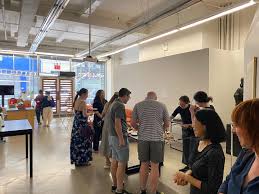
The Shinnyo Center NYC, formally The Shinnyo Center for Meditation and Well-being in New York City, is a temple and meditation center within the Shinnyo-en Buddhist school. The center, which was founded in 2014, was born out of the desire of Shinnyo-en’s leader, Her Holiness Shinso Ito, to “make a contribution to the New York [City] metropolitan area, both to members of the general public and as well as to…organizations headquartered” there (Shinnyo Center Website, About). Since its founding, the center has been located at 19 W 36th Street, in Midtown Manhattan. The center is staffed by guides who have been trained for over a decade in the “Shinnyo forms of meditation” (Shinnyo Center Website, Meditation) and who have been described as “friendly and knowledgeable” (Yelp). Patrons have described the facilities as “really peaceful,” “bright and comfortable,” “warm,” and “safe” (Yelp).
In order to understand the goals, practices, and activities of the Shinnyo Center, it is necessary to understand the Buddhist school it is a part of, including the school’s founding, focuses and goals, and practices. The Shinnyo-en Buddhist School was founded in 1936 by a husband and wife, Masters Shinjo Ito and Tomoji Ito. The school was originally birthed out of Shingon/Esoteric Buddhism, and “follows the line of esoteric/Shingon Buddhism, with a strong link to the Daigoji denomination” (Oxford Bibliographies). In 1946, after religious controls in Japan were loosened, the school separated from Esoteric Buddhism, and in 1951, was renamed Shinnyo-en, meaning “Boundless Garden of Shinnyo (truth).” Shinnyo-en quickly spread around the world, and by the time Master Shinjo visited the United States in 1970, he was able to meet with Shinnyo-en members in Los Angeles, Chicago, Buffalo, San Francisco, and Hawaii. After the death of Masters Shinjo and Tomoji Ito, their daughter, Her Holiness Shinso Ito took over in 1989 and continues to lead Shinnyo-en (Shinnyo-en Buddhism Website, About Shinnyo-en, Our Story).
Importantly, Shinnyo-en is directed at a lay community and is not a monastic order. Shinnyo-en holds that with sincere effort, anyone can achieve liberation, which is why the school is called the “boundless garden of Shinnyo.” This belief comes from Shinnyo-en’s main text, the Mahāyāna Mahāparinirvāņa Sūtra, which stresses, among other things, the “buddha-nature” that exists innately within all sentient beings and that enables those beings to achieve liberation (Oxford Bibliographies).
There are three main dimensions to Shinnyo-en Buddhist practice: other-focused integrity, meditation, and wisdom. The first, other-focused integrity, itself consists of three parts: (1) service, which includes volunteering, community service, and “small interpersonal acts of service;” (2) joyous giving, which includes donating any amount of time, money, or other offerings to community service organizations or giving attention to those who need it; and (3) spiritual care, which involves setting aside judgment to care for, converse with, and otherwise support others.
The second aspect of Shinnyo-en practice is meditation—the main goal of the Shinnyo Center NYC. Shinnyo-en practices a specific form of seated meditation derived from Esoteric Buddhism called sesshin, “touching the essence of buddhahood.” In formal sesshin, also known as “structured sesshin,” a follower meditates with a “spiritual guide” who offers words of guidance to the meditator (Shinnyo-en Buddhism Website, About Shinnyo-en, Our Practices).
The goal of Shinnyo-en, and the third dimension of Shinnyo-en practice, is wisdom, which refers to the “shift in perspective that allows one to clearly see the independent nature of the world, just as it is.” According to the Shinnyo-en Buddhist website, “Shinnyo” can be understood as “as-it-is-ness” or “the essential nature of reality,” which must be understood to achieve enlightenment. In addition to practicing the first two dimensions, followers can develop wisdom/Shinnyo by listening to teachings from the founders (Masters Shinjo and Tomoji Ito), Her Holiness Shinso Ito, or from qualified teachers (Shinnyo-en Buddhism Website, About Shinnyo-en, Our Practices).
The last thing that must be understood about Shinnyo-en in order to assess its center in New York City is prayer sessions. Shinnyo-en prayer sessions are meant to be done daily and are very structured, consisting of Beginning Prayers, Middle Prayers, and End Prayers. The sessions can also be broken down according to their three focuses: (1) seeking refuge in the 3 Jewels; (2) chanting prayers and reciting mantras, which always include the chants of Goreiju and Jojusan; and (3) dedicating merits, selflessly offering the merits you earned in that prayer session to others so that you attain enlightenment for the benefit of all living beings.
Because Shinnyo-en is a lay-focused school, it adapts to the local population and environment. To this end, the Shinnyo Center NYC differs from its parent school in two important ways: firstly, it is considerably more secular, appealing to the local population, which is almost entirely not Buddhist and often not religious at all, and, second, it markets itself as a break from the bustle of the city. To the first point, the center says that their Shinnyo Guided Meditation “is not a religious practice” (emphasis added). This differs from the Shinnyo-en Buddhism website, which calls meditation a “Buddhist discipline.” Additionally, the Shinnyo Center says it welcomes anyone to participate, regardless of their faith (The Shinnyo Center Website, Meditation). The second point may be more obvious: New York is a massive, busy, and often impersonal city that many might enjoy a break from. To that end, one of the Shinnyo Center’s goals is to provide an “oasis” in which New Yorkers can “find a few moments of quiet and reflection.” Additionally, recognizing that patrons have to go back to busy lives, the center aims to “improve life ‘off the cushion’ and not just to be an experience in the meditation hall” (The Shinnyo Center Website, Meditation).
The practices of the Shinnyo Center are based directly on the aforementioned Shinnyo-en practices, but also differ in notable ways. In the center’s sessions, an experienced Shinnyo-en clergy member leads the patrons, but there is no required “ritual,” which differs from the highly structured prayer sessions detailed above, or “postures,” which differs from the fairly specific postures in sesshin meditation (The Shinnyo Center Website, Meditation). Additionally, the Shinnyo Center NYC has sessions/events that are not inconsistent with Shinnyo-en practice, but that are outside of traditional Shinnyo-en practice. Examples of these sessions include their “Shinnyo Urban Half-Day Retreats” on Saturdays; their Jazz Meditation events; Matcha Meditation, which are evening guided meditation sessions combined with matcha tea ceremonies; public meditation sessions on Zoom on Fridays (The Shinnyo Center Website, Meditation); and self-guided meditation wherein patrons can sit in the temple on their own to meditate (Yelp).

Another important aspect of the Shinnyo Center NYC is its initiatives and other community work. As an extension of Shinnyo-en’s commitment to Other-Focused Integrity, the first dimension of Shinnyo-en practice, comprised of service, joyous giving, and spiritual care, the Shinnyo Center has partnered with “non-profit, educational, social service and cultural institutions, first responders, private corporations, religious organizations…municipal authorities, universities,” and other groups and individuals, facilitating guided meditation sessions and other special events for them (The Shinnyo Website, Partnerships). As an example of the variety of partnerships that the center has had, they have partnered with both the New York Police Department and—completely separately—Riker’s Island Prison inmates (The Shinnyo Center Website, Initiatives) (The Shinnyo Center Facebook).
The center’s efforts to help local organizations is consistent with the center’s apparent efforts to be involved in the local community. The center maintains a strong social media presence, with X/Twitter, Facebook, and Instagram pages, all of which are public and display instructional and inspirational videos and quotes from Shinnyo-en clergy. As an example, Reverend Qalvy Grainzvolt of the Shinnyo Center frequently posts mindfulness and meditation videos. As a result of their engagement with the community and their flexible practice, the Shinnyo Center appears to be patronized by a multi-racial, multi-religious group of locals of varying ages, with most being younger adults and middle-aged people ( the center’s social media sites, generally).
According to the Shinnyo Center’s publicly-available IRS 990 forms, the center is a fairly small operation registered as a 501(c)(3), a tax exempt non-profit organization. In Fiscal Year 2023, the center’s net assets were $95,107, down $8,420 from the previous fiscal year: the center only reported $3,150 in total revenue (all from program service revenue) and $11,920 in total expenses. Because it reported no “investment income,” the center does not appear to have any endowment or investments. In previous years, though, they received sometimes tens of thousands of dollars in grants and contributions, which explains why they have over $90,000 in net assets despite five consecutive years of (often large) operating deficits. According to one Yelp review, the center’s self guided meditation is free, guided meditation sessions carry a “nominal fee,” and special meditation workshops (like the Jazz and Matcha workshops) carry a fee—these the only apparent sources of income for the center.
Evidently buoyed by timely contributions from outside sources, the Shinnyo Center for Meditation and Well-being in New York City has been able to create an environment that has been described as “the best place to meditate in Manhattan” (Yelp). The center has substantially preserved the goals and values of Shinnyo-en Buddhism while adapting Shinnyo-en practices and rituals to fit the unique needs of a Buddhist meditative center in New York City, New York. The center has engaged meaningfully with community partners and has promoted a version of Buddhism that well compliments the pace of modern city living.
Bibliography:
Shinnyo-en Buddhism Website: https://shinnyoen.org/
Shinnyoen, Oxford Bibliographies: https://www.oxfordbibliographies.com/display/document/obo-9780195393521/obo-9780195393521-0275.xml
Shinnyo Center Website: https://shinnyocenternyc.org/
Shinnyo Center Instagram: https://www.instagram.com/shinnyocenternyc/?hl=en
The Shinnyo Center Yelp Page: https://www.yelp.com/biz/the-shinnyo-center-for-meditation-and-well-being-new-york
The Shinnyo Center Facebook: https://www.facebook.com/shinnyoNYC/
IRS 990 Form (and CauseIQ.com analysis): https://www.causeiq.com/organizations/view_990/471852709/d6188541ce81e64ca94bc75f07466195