
Won Buddhism
Il Won (One Circle) is the Dharmakaya Buddha, the origin of all things in the universe, the truth to which all buddhas and sages become enlightened, and the original nature of all sentient beings.
Sotaesan
Won Buddhism (Won-Bul-Kyo in Korean) was founded in Korea in 1916 by Venerable Sotaesan (Park, Joongbin 1891-1943) after achieving enlightenment. It was created as a more practical and accessible practice of Buddhism which could be accessible to all people. Sotaesan found importance in equality between all people no matter their gender or social class, and he would simplify teachings to make them relevant to the people he was teaching and their everyday lives. “Won” means circle, which symbolizes the ultimate truth; “Bul” means enlightenment, symbolizing the realization; and “Kyo” means teaching, symbolizing the path to awakening. Sotaesan’s idea of equality is a core aspect of the founding moto:
With this Great Opening of Matter,
Let there be a Great Opening of Spirit.
Sotaesan
The Won Buddhist tradition focuses on two core principles of mind practice and gratitude. Mind practice works towards awakening by calming the mind and practicing focused wisdom in daily tasks. Gratitude emphasizes that people exist through community and mutual support. Together these two practices guide people to awakening and living with compassion and balance
In Won Buddhism the eightfold path is condensed into the Threefold Practice: Cultivation of Spirit, Inquiry into Human Affairs and Universal Principles, and Choice in Action. Cultivation of Spirit is practiced through meditation and prayer to settle down and focus the mind. The analogy used to describe it is “It is like weeding a field before planting seeds.” Inquiry into Human Affairs and Universal Principles is practiced through scripture study, koan practice, and dharma discussion in order to maintain the wisdom of ones Buddha Nature, human affairs, and universal principles. Choice in Action and maintaining compassion of our own Buddha Nature is practiced through observing precepts, mindfulness practice and the subjects of mindful choice in action in order to maintain compassion.
The Fourfold Grace is a central teaching in Won Buddhism which categorizes everything in people’s lives into four categories. Grace in Won Buddhism implies co-existence and interdependence. The first is the grace of heaven and earth which refers to all natural things that allow us to exist such as air and water. The second is the grace of parents who with their care and love support an individual. The third is the grace of fellow beings which are the people in a person’s life who support them, from a friend to the farmer who grew the food a person is eating. The last one is the grace of laws which refers to the community and social structures of society.
Sotaesan

Chung-bin Park, also known as Sotaesan, was born in 1891 as the son of peasants. His path to awakening started with his philosophical questioning of the world. At 26 years old in 1916 he reached enlightenment and stated:
“All things are of a single body and nature; all dharmas are of a single root source. In this regard, the Way (Tao) that is free from arising nor ceasing and the principle of the retribution and response of cause and effect, being mutually grounded on each other, have formed a clear and rounded framework.”
Sotaesan
For 28 years which included the darkest period of World War II, Sotaesan guided Won Buddhism with clarity and strength. Through his three core missions, edification, education, and charity, he established the foundation that continues to support the movement today. He shaped the essential doctrine of Won Buddhism, including Il Won Sang, the Fourfold Grace, and The Threefold Study. In 1943 at 53 years old he entered Nirvana but before passing he gave his disciples the verse of truth:
“Being into nonbeing and nonbeing into being, Turning and turning— in the ultimate, Being and nonbeing are both void, yet this void is also complete.”
Sotaesan
Temple

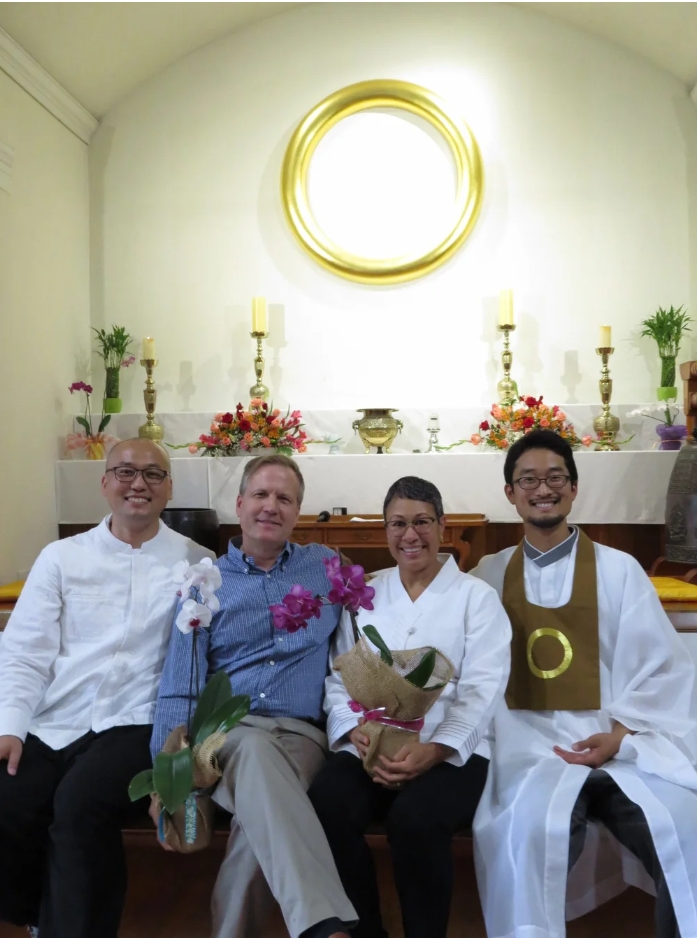
There is no exact date listed for when the temple was built but they incorporated as a nonprofit under the name “Won Buddhism of Philadelphia, Inc.” on July 1, 1987, so it can be assumed they were founded around that time. The temple is in a refurbished church so the surrounding Korean community must have come together in this building, which then expanded into the community it is now. The temple now serves both Korean‐language and English‐language congregations and offers services, meditation, and community outreach, and operates a community service center in their basement.
The temple offers both lay teachers and monastic teachers for guidance but is primarily lay-based. Some of the teachers are converts meaning that they were not born into Buddhist tradition. It does not appear that anyone lives in the temple though, so it can be assumed that all teachers commute. The Temple also occasionally brings in guest teachers for events who may travel from afar.
Mission
“Our Temple serves as a spiritual home for people who practice meditation and follow the path of Buddhist teachings, in order to bring peace, compassion and wisdom to our lives, our community and the world.”
Membership and practice are open to people of diverse ages, backgrounds, and even religions so a person does not need to be a Buddhist to benefit from meditation and Buddhist teachings.
Schedule
The Won Buddhism of Philadelphia temple offers in-person Dharma Service in both Korean and English. These services include sitting meditation, chanting, prayer, hymn and dharma talk on Won Buddhist philosophy and practice. They also offer various meditation gatherings where they practice various forms of meditation (sitting, chanting, walking, moving, prayer, etc.).
They also offer online meditation services and study groups through zoom. The study groups focus on different subjects such as the Mind or scripture and may have a book or specific text they are looking at.
Additionally, they have retreats that span from half a day to multiple days, gatherings, memorial services, celebrations, Dharma Arts classes, and more.
All of their programs are done by donation and often a suggested donation is listed from $5 – $20

By: Alessia Crisafulli
References
Won Buddhism — Won Buddhism of North Carolina
Won Buddhism of Philadelphia Incorporated in Glenside, Pennsylvania