Located just north of Salt Lake, the Buddhist Church of Ogden stands as a community hub for Jodo Shinshu Buddhists of both heritage and convert backgrounds. The Church is part of the Jodo Shinshu Hongwanji-ha organization and the Buddhist Churches of America (B.C.A.) and shares its minister, Rev. Jerry Hirano, with the nearby Salt Lake City and Honeyville Buddhist Temples. As part of the greater community of Buddhist Jodo Shinshu temples in the United States, the Buddhist Church of Ogden seeks to provide an experience of Buddhism that bends Japanese tradition with emerging ideas to best suit the needs of its present day community.
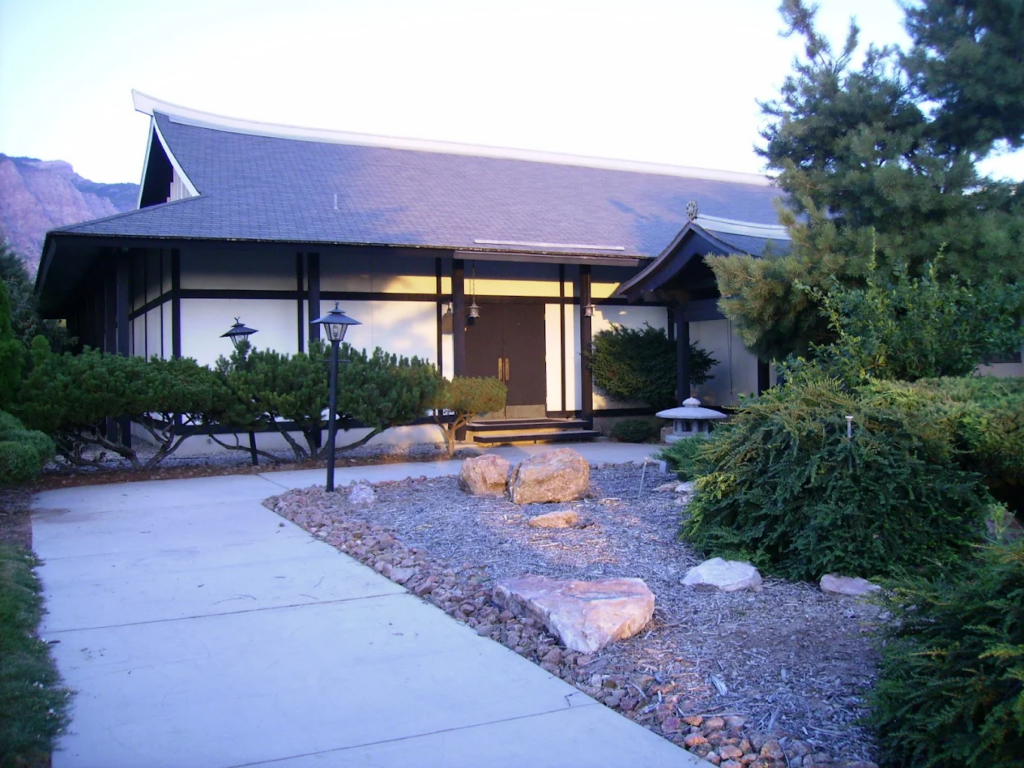
Temple exterior; Ernest Keyd on Google
History
Japanese immigrants first began arriving in the United States in the 1880s as railway workers. Early Buddhist communities were established along the West Coast with the first American Jodo Shinshu community founded in 1899. The Ogden sangha (community of Buddhists) began meeting in 1913 in the private homes of Japanese immigrants. After a minister from San Francisco arrived to assist with rites, the sangha gradually expanded its meeting places to renovated storefronts in Ogden’s Japantown. The Buddhist Church of Ogden was officially established in 1943 by its minister, B.C.A. head and Topaz internment camp survivor Rev. Kenryo Kumata. Initial efforts to construct a temple were met with protests by the non-Japanese community of Ogden, but the current building would eventually be completed and dedicated in 1964.
Throughout its history, the Buddhist Church of Ogden has been defined by persistence and survival among its Japanese members, many of whom faced racial, religious, and ethnic discrimination since the arrival of Japanese immigrants in the 1880s through the internment era and into the modern day. Today, the Church serves a blended community of heritage Jodo Shinshu Buddhists and converts. The ministry has been lead by both Japanese-born and American-born Buddhist leaders since its founding and all ministers to date have been of Japanese descent.
The current minister of the Buddhist Church of Ogden is Rev. Jerry Kyosei Hirano, a Salt Lake City native with credentials from the University of Utah, the Institute of Buddhist Studies in Berkeley CA, and Chuo Bukkyo Gakuin in Kyoto. Rev. Hirano received his ordination from Nishi Hongwanji. Along with the Buddhist Church of Ogden, Rev. Hirano is also the minister of the Salt Lake Buddhist Temple and the supervising minister of the Honeyville Buddhist Church. The Buddhist Church of Ogden is also lead by assistant ministers Rev. Geoffrey R., Rev. James K., Charles A., and Annette K., and temple president Michael K.
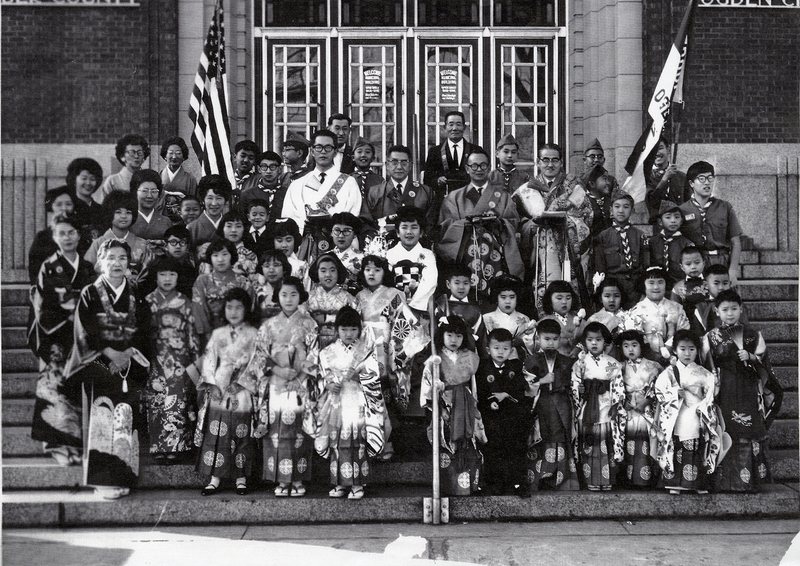
Members of the community in 1964; Weber University Archives
Practices
Jodo Shinshu was established by Shinran in the 12th century as a form of Pure Land Buddhism. In traditional Pure Land, the nembutsu ( Namu Amida butsu) is recited throughout the day in order to gain special moments of remembrance that would allow the practitioner to reach Amida’s Pure Land, where awakening could more easily be achieved. Practitioners would also be expected to perform other virtues in pursuit of the Pure Land. Rather than emphasizing actions, Shinran taught that faith in Amida (Amitabha Buddha) alone could lead to the Pure Land and subsequent enlightenment. Recitation of the nembutsu is done instead as an expression of faith and recognition of Amida’s grace. The Buddhist Church of Ogden practices Jodo Shinshu Buddhism in the tradition of the Jodo Shinshu Hongwanji-ha organization, which began as a temple at the mausoleum of Shinran and, with the guidance of the 8th Hongwanji leader Rennyo Shonin, expanded into a significant sect of Jodo Shinshu. Hongwanji-ha includes the writings of Rennyo Shonin among its scripture as well as the writings of Shinran Shonin and the Pure Land Sutras.
As a Jodo Shinshu temple, the Buddhist Church of Ogden recites nembutsu during services and recommends remembering Amida in one’s life outside the temple, such as when taking meals. Standard services are held on Sundays and include:
- Oshoko (the burning of incense to begin the service, symbolic of opening one’s mind to the dharma)
- Onaisen (donations to the temple collected during oshoko)
- Sutra chanting from service books, written in English and Japanese
- Recitation of the nembutsu throughout the service
Members pray and recite nembutsu in the gassho position with hands clasped and encircled by onenju beads, an adapted form of Buddhist prayer beads symbolizing the presence of Amida. Standard services are held on Sunday afternoons, with special services held for Buddhist holidays and events. Special services include:
- Joya-E, a celebration of New Year’s Eve
- Obon, a joyous festival day for remembrance of ancestors
- Hoonko, the memorial for Shinran Shonin
- Hanamatsuri, the celebration of the Shakyamuni Buddha’s birth
- Bodhi Day, the celebration of the Shakyamuni Buddha’s enlightenment
- Nirvana Day, a memorial for the Shakyamuni Buddha celebrating his achievement of parinirvana
- Shotsuki Hoyo, monthly memorials for members who passed in that month in previous years
- Hatsumairi or infant presentation, in which an infant receives their first onenju
- Eitaikyo, a ceremony recognizing past donors to the temple
- Weddings and funerals
Donations are welcomed by the Church as an expression of gratitude and charity by members of the community. The Buddhist Church of Ogden suggests that members give during special services, events like funerals, weddings, and celebrations of birth, and as thanks for goods or services by the temple.
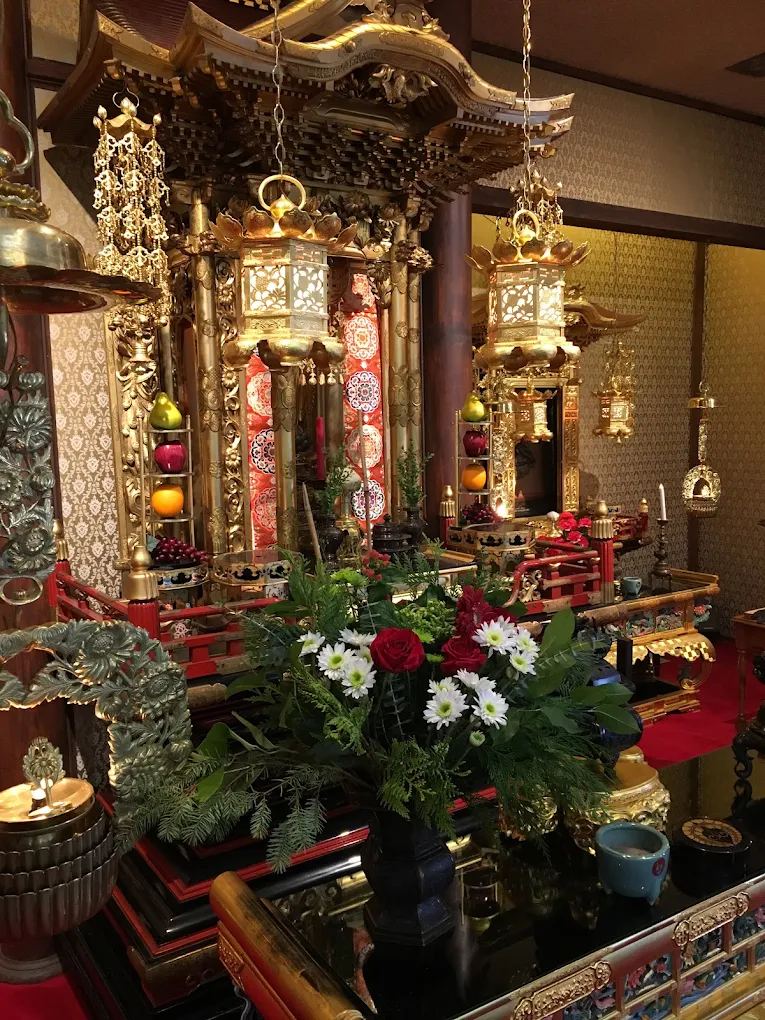
Altar; Ernest Keyd on Google
The Buddhist Church of Ogden views itself as part of the larger story of Jodo Shinshu in the United States and aims to continue that legacy by adapting Jodo Shinshu practice and teachings to new perspectives. As part of this mission, the temple regularly holds community events, invites guest speakers for special services, maintains a glossary of Japanese terms for new members, and publishes a bimonthly newsletter (the Geppo). The Geppo is available to be read on the Buddhist Church of Ogden’s website and includes event calendars, information about upcoming activities, memorials, and writings by Rev. Hirano regarding his personal experiences with dharma.
Conclusion
The Buddhist Church of Ogden stands as a pillar of its Japanese-American community, a reminder of their strength, effort, and power of self-determination in the face of hardship. Today, the temple serves its sangha by providing a meeting place for community events and resources for its Japanese-American and convert Buddhist members. By welcoming all who wish to come with open arms and maintaining an open, innovative perspective on Jodo Shinshu teachings, the Buddhist Church of Ogden has created a space where members can find safety, compassion, and faith among the difficulties of daily life.
Citations
“About Jodo Shinshu Buddhism: Buddhist Holidays.” Midwest Buddhist Temple, https://mbtchicago.org/about-jodo-shinshu-buddhism/buddhist-holidays/.
“About the Buddhist Church of Ogden.” Buddhist Church of Ogden, https://www.ogdenbuddhistchurch.org/blank-2.
“History of the Hongwanji.” Jodo Shinshu Hongwanji-ha (Nishi Hongwanji), https://www.hongwanji.or.jp/english/history/index.html.
“Jodo Shinshu.” The Buddhist Society, 2025. https://www.thebuddhistsociety.org/page/jodo-shinshu/.
“Reverend Hirano.” Salt Lake Buddhist Temple, https://www.slbuddhist.org/hirano-sensei.
“Special Services & Holidays.” Buddhist Church of Ogden, https://www.ogdenbuddhistchurch.org/blank-7-1.
“The Essentials of Jodo Shinshu – My Path.” Jodo Shinshu Hongwanji-ha (Nishi Hongwanji), https://www.hongwanji.or.jp/english/teaching/index.html.
“Visitor’s Guide.” Buddhist Church of Ogden, https://www.ogdenbuddhistchurch.org/blank-4.
Buddhist Church of Ogden Ministry. “November/December 2025 Issue.” The Geppo, Buddhist Church of Ogden, September 2025, https://www.ogdenbuddhistchurch.org/_files/ugd/b0377a_6072a9a5c7114d5c92d24c10d5c132ea.pdf.
Buddhist Church of Ogden Ministry. “September/October 2025 Issue.” The Geppo, Buddhist Church of Ogden, September 2025, https://www.ogdenbuddhistchurch.org/_files/ugd/b0377a_3e84560891644119a96351d64c7da4c2.pdf.
Isabella Holt, Brigham Young University. “Ogden Buddhist Church,” 3 Oct. 2025, Intermountain Histories, 2025, https://www.intermountainhistories.org/items/show/760.
Keyd, Ernest. Untitled (Altar). 2018. Buddhist Church of Ogden, Google. Accessed 8 December 2025. https://lh3.googleusercontent.com/gps-cs-s/AG0ilSzmCCM0GD6kM73RBFqdMyhRpXDuew0CnifwNZ4dlsWsOGSXp3lBVrrmBlw1ulpiXfHvKOMYbFVqmMYOpnPJRWBKzrtIQe1M7oS_JLOUXNEf9LL79h231t3_dogUTFP1IOKKIX4=s1360-w1360-h1020-rw
Keyd, Ernest. Untitled (Exterior). 2017. Buddhist Church of Ogden, Google. Accessed 8 December 2025. https://lh3.googleusercontent.com/gps-cs-s/AG0ilSy6CgkQEQN1R7C9_O91rAI-bSApInWv2MQ4Rh2i9ydcxaSeMQN40mO0J-cpj5z7dMikmOICmf6MWuoZtIuP_21Zr3kRGY0GRfgcGRP9dW_o6PYyCf_j06l94CvwE569Tkm7K1kG9w=s1360-w1360-h1020-rw
Unknown. Members on the steps of the City and County Building in 1964. 1964. 50 Stories for 50 Years, Special Collections and University Archives, Weber State University. Accessed 8 December 2025.
Weber State University. “Japanese Buddhist Temple, 1913.” 50 Stories for 50 Years. https://exhibits.weber.edu/s/SC50/page/buddhist.